Sunday, 3 April 2011

Ground 159: Grounsell Park, Heaton Stannington

Grounsell Park is one of Newcastle’s less well-known football grounds, tucked behind a chip shop, delicatessen and a Cantonese takeaway in a trendy student suburb of the city’s east end. It’s the quarter final of the George Dobbins League Cup, the visitors are Percy Main Amateurs, and after January’s rain aborted trip, it's my second attempt to see Heaton Stannington play at home.

On paper the two teams are about as evenly matched as it’s possible to get: seventh and eighth in the Northern Football Alliance Premier Division, with only two points and three goals keeping them apart. The visitors – formed in 1919 by Great War veterans – have the longer history, Heaton - founded around the same time Hitler was marching into Poland two decades later – the slight edge on the pitch, having returned from Percy Main with a 2-1 victory back at the start of the season. Encounters between the two sides haven’t always been friendly. Five years ago a twenty-one man brawl over a disputed throw-in led to the abandonment of a goalless league game with just a handful of the ninety minutes left to play.

Never the most successful club on the pitch, Heaton nevertheless managed seven seasons in the Northern League either side of the Second World War, disbanding after a 12th-placed finish in 1952. The club reformed in the late-1970s and played out five uneventful seasons in the Wearside League before joining the Northern Football Alliance in 1986. Along the way, they made it through fourteen FA Cup ties and as far as the third round of the 1974-5 FA Vase, losing 2-0 in a replay to Wallsend Town. Last promoted to the Northern Alliance Premier in 2004, their best effort in recent years was finishing fourth behind Team Northumbria two seasons later.

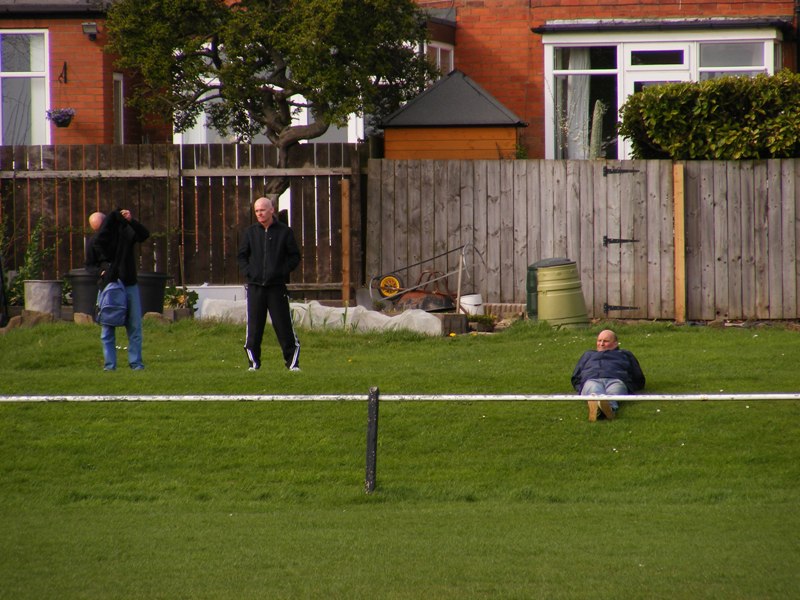
Except for the bobbles on the pitch, Heaton’s facilities are positively salubrious for this level of football, with a metal entrance gate, a two-storey clubhouse, and parking spaces and picnic benches facing on to the pitch. The dugouts are separated by the width of the halfway line, and a grassy bank slopes up towards wooden fences and back garden washing lines on the far side of the ground.

With the wind gusting at their backs, Percy Main have the better of the early play but lack composure in front of goal. Heaton have a header brilliantly tipped over the bar and another barely scrambled away for a corner. The visitors, with Pierre-luc Coiffait’s throw-ins inducing bouts of mild panic in the Heaton defence, have a goal disallowed for a push before the break, but it’s the home side who eventually put the ball in the net ten minutes into the second half, a long punt upfield hooked past Rob Rodgerson before he can scramble off his line. It’s two shortly afterwards – if I was a tabloid journalist I’d be shoehorning in a Stannington turn up the Heat reference right about now - the ball bobbling around the edge of the area before it’s dispatched low into the corner. When a third goal follows soon after the hour mark, the game’s as good as over. Unfortunately, the same can’t be said for my digestive process, which is still suffering as a result of the Kilimanjaro-sized portion of chips I’ve been working my way through ever since half-time.
Main pull a goal back from a late penalty but with ten more matches to play this month and a Northumberland Senior Benevolent Bowl final to come against Seaton Delaval Amateurs, their disappointment is tempered with relief at having one fewer game to schedule between now and the end of the season. Heaton march on to a last-four game meeting with Whitley Bay ‘A’, Blyth Town or Ashington Colliers awaiting the winners in the final.

Admission: Free
Date: 2nd April 2011

Friday, 1 April 2011

Ground 158: Silksworth Welfare, Silksworth

The further down the league pyramid you go, the less expendable people - players, managers, tea ladies and even the proverbial one man and his dog watching from the touchline - become to a football club. So while Newcastle United could afford to sack a manger whose team sat 11th in the table and had recently thrashed their local rivals 5-1, for Silksworth FC, a struggling team ten whole divisions below the Premier League, losing boss Steven Smith is, quite literally, a matter of life and death.

Until the middle of the 19th century Silksworth was little more than an area of farmland three miles south of Sunderland. When the Marquis of Londonderry sank the village’s first coalmine in 1869 there were fewer than 600 people living in the neighbouring hamlets of Silksworth and Tunstall. Within a decade the population had risen tenfold and more than 2,000 men and boys – some from as far afield as Germany and the USA - were working shafts up to six hundred feet underground in what became Londonderry’s showpiece mine.

Among the tens of thousands of people who would eventually work the mine was a man called Joe Gurney and three of his four sons. The other, Bobby, played for Silksworth Boys, Hetton Juniors, Seaham Harbour and Northern League Bishop Auckland, where he was spotted by Sunderland manager Charles Buchan and signed for a fee of £10 in 1925. Gurney scored nine goals on his debut for Sunderland’s reserve side, and netted after just nineteen minutes of his first team debut against West Ham the following year. Over the next two decades – and despite suffering three broken legs – he played 388 times and scored 228 goals for his hometown club, including ten hat-tricks and the opening goal of the 3-1 1937 FA Cup Final win over Preston North End. In 1936 his goals helped Sunderland to the First Division title - the last time Sunderland (or indeed any team wearing stripes) have finished champions of England. Despite this, he managed only a single England cap, appearing in front of a crowd of 129,000 at Hampden Park in 1935. After retiring as a player at Sunderland, Gurney managed Peterborough United, Darlington and Hartlepool. He died in April 1994. A blue plaque outside the Silksworth Welfare ground commemorates his birthplace in nearby Stewart Street.

When Silksworth Colliery closed in the 1970s, the town – by now a suburb of Sunderland itself – was forced to reinvent itself. A sports complex was eventually constructed with floodlit football pitches and Europe’s largest dry ski slope, while parts of the old mine were turned into a boating lake and skateboard park. In summer 1998 a man called Steven Smith reformed the town’s football team, once known as Silksworth Colliery Welfare, as Thorndale FC. Chairman and manager, Smith wanted a make a club where local people could get together and play a game of football. Almost thirteen years on - and now known as Silksworth Community Football Club - his team has progressed through the Hetton and District, Tyne & Wear and Durham Alliance Leagues, raised over £12,000 for local charities and seen almost two hundred different people turn out in its colours. Next season would have been Silksworth’s fifth successive year in the Wearside League, but work commitments mean Smith can no longer devote Saturday afternoons to football. Without their manager, the club had little option but to fold. “It’s really disappointing we’ve had to take this decision but there was no other option,” Smith told the Sunderland Echo. “Only one player has left and we will fulfil our 14 fixtures, hopefully going out in a blaze of glory.

While results haven’t quite matched up to the optimism of Smith’s pledge, recent wins over Willington and basement-dwellers Prudhoe Town have propelled Silksworth out of the Wearside League’s bottom three, where they’d been stuck for much of the season. With nine games remaining, they’ve climbed to sixteenth in the table, five places and nineteen points behind this evening’s opponents Hartlepool FC.

Hemmed in on two sides by the flowerbeds, war memorial and Victorian bandstand in Silksworth Park, the Welfare Ground has a brick clubhouse in one corner and a pair of upright metal dugouts on halfway. When we arrive both are still locked and the players are waiting in the centre circle while a Silksworth official attempts to hunt down the key. “No luck?” asks the referee. “Tell you what, get your subs behind the fence and we’ll just crack on.”

Unfortunately for Silksworth, it’s the visitors who do most of the early cracking, deservedly taking the lead when the home keeper blocks a shot only for the rebound to falls straight into a Hartlepool forward’s path, the Silksworth defence appealing in vain for offside. With the unhappy keeper still haranguing his defence – “There’s no talking, no movement, nothing” – a Hartlepool player advances through midfield and lobs the ball from thirty yards into the roof of the net. “Is anyone gonna put a foot in?” the keeper demands after picking himself off the floor. “Inept,” comes from the Silksworth bench in a semi-audible moan. “That was like Brazil!” a Hartlepool fan celebrates as the scorer is mobbed by his teammates.

Silksworth reduce the arrears with a samba strike of their own, a shot from the edge of the area lashed past the helpless keeper. They smash a shot off the crossbar and have a header beaten off the line. Somehow, Hartlepool miss a one-on-one, the forward lifting his shot over the keeper, the goal and very nearly the fence at the back of the pitch. Half-time comes with neither side quite able to add to their score.

Hartlepool emerge for the second half in the same mood they began the first but find themselves just a single goal ahead when their goalkeeper unwisely allows an angled cross to bounce twice in his area, the second clearing his head and finding its way into the far corner of the net. But the prospect of parity only spurs the visitors on. Two minutes later a free kick is parried away from goal and not one but two forwards are on hand for the resulting tap-in, and though a Silksworth substitute manages to pull a goal back, it’s too little, too late to save his side from defeat.

Eight games left in the life of Silksworth Community Football Club.

Admission: Free
Date: 30th March 2011

Tuesday, 22 March 2011

Northern League Haiku

To mark World Poetry Day, a few thoughts on the world's second oldest football league in seventeen syllables or fewer.


Turin. On the pitch
Eleven Durham miners
Run rings around the world.

The goalkick bounces.
“Mine!” he yells, his eyes alight.
He shoots at the moon.

Crook – Barcelona.
To Messi, Cruyff, Kubala:
Your boys lost 4-2.

Flooded goalmouth
The keeper dives
A fraction too soon.

The old pitch
They both fly in
Thwack!

Wednesday, 16 March 2011

Ground 157: Seaham Welfare

Put it down to the ineffable appeal of Northern League football, but while most of the nation’s fans are sitting at home in front of the fire, watching Manchester United battle Marseille for a place in the last eight of the European Champions League, I’m waiting in the mist for a delayed kick-off at Seaham.

First formed as a Sunday League team in 1973, Seaham Red Star progressed through the Houghton & District, Northern Alliance and Wearside Leagues after making the switch to Saturday afternoons. In 1979, with 62-goal Tommy Henderson and future Huddersfield, Derby County and Leeds forward Bobby Davison leading the line, they got as far as the fifth round of the FA Vase before losing 5-2 at home to eventual semi-finalists Whickham, then triumphed in the Philips Floodlit Trophy at Birmingham’s Alexander Stadium, winning a set of floodlights for their Seaham Welfare ground. A year later Red Star defeated Boldon at Roker Park to lift the Durham Challenge Cup, after eliminating a Tow Law Town and a young winger called Chris Waddle at the semi-final stage. In 1982, helped by Nigel Gleghorn, a fireman who would go on to play for Ipswich, Manchester City and Birmingham, and eventual New Zealand international striker Paul Nixon, Red Star once more made it to the fifth round of the Vase and managed the Wearside League and Challenge Cup double.

Admitted to the second division of the Northern League two seasons later, Seaham were promoted behind Stockton in 1988 and finished fifth in 1993, when they won the Northern League Cup and sold their 17-year-old goalkeeper to Newcastle United. “I played a dozen games in the Northern League, a tough league with some good players but a learning experience for a young lad,” Steve Harper remembered in a recent interview with the Daily Mail. “I was spotted by Peter Kirtley and asked to play for Newcastle's youth team.” Third the following season, they finished as high as second behind Bedlington Terriers in 2000, but were relegated with just twenty points in 2002. It took another five seasons for Seaham to return to the top flight, and only two more before the plummeted once again after their main financial backer abruptly withdrew all funding weeks before the start of the 2008-2009 season.

Last year Red Star managed midtable. This season things are much worse: after conceding 88 goals in just 29 games, the weekend’s 3-0 home defeat by Hebburn Town has left them just two points above Horden Colliery Welfare in the third and final relegation place. “We’ve got to get out of the blocks quickly tonight and see what Whitehaven are made of,” manager Kevin Turns tells the Sunderland Echo before the game.

Seaham’s young side, with two players out suspended and three unable to get time off work, are faster around the pitch but fall behind to an early Whitehaven goal from a corner – a near identical effort to the one the visitors scored at the weekend, when I saw them battle to a 1-0 win over promotion chasing North Shields. The Cumbrians double their lead when a swift passing move dissects the Red Star defence and Craig Robson rolls the ball low into the corner. “Start again, start again,” is the advice from the home bench. “Closer, man!” comes a less-forgiving shout from the back row of the stand. “Weak as piss, that.”

But start again they do. They have a goal disallowed, then score from a free kick that Richard Goodman chests down, stumbles over and strikes past Brian Miller in the Whitehaven goal. Not half an hour gone and we’ve already had three goals. “See how easy it is? See how easy it is?” asks Turns. He gets his answer within a minute, Goodman replicating the game’s opening goal with a header into the roof of the net. Whitehaven see a shot clang back against the metal post, but then a gentle lob from Johnny Monaghan somehow squirms through Miller’s arms and ends up in the net. He looks straight down the pitch, utterly aghast. Nobody quite has the heart to celebrate.

It takes twenty minutes of the second half for Whitehaven to get back on level terms. A player skips past a challenge on the right and the Seaham defence leave Kevin Connelly unmarked to turn in the cross at the far post. With just three minutes left, and Red Star having just gone close to a winner of their own, the visitors break upfield and Connelly scores a fourth. Beaten, there’s still enough time for Seaham’s Paul McSween to save a penalty and Gregg Qually to score from the rebound. “Plenty of goals, like,” a Seaham fan says as he heads for the exit. “Aye,” his friend replies, ruefully shaking his head, “but at the wrong end.” They miss Connelly completing his hat-trick in scoring Whitehaven’s sixth goal. Not that it matters much by then.


Admission: £4
Date: 15th March 2011

Monday, 14 March 2011

My First Game

Newcastle United 0 Coventry City 1
St. James’ Park
April 17th 1985
Attendance: 19,577


I had just turned nine years old, it was a sunny, end-of-season Wednesday evening, and Newcastle United were playing at home to Coventry City. It was the day that Manchester United beat Liverpool to reach the final of the FA Cup, exactly a week before Everton made the Cup Winners Cup Final, and just under a month until Heysel and the Bradford Fire. Not that I knew any of this at the time. Besides, I had enough to think about just trying to stay upright on a concrete crash-barrier.

We arrived before kick-off, climbing the zig-zag steps up from outside The Strawberry pub, the doors of which men would famously topple out of five minutes before the game began. There was the smell of cooking hops and barley from the brewery next door, mixed in with open-air urinals, cigarette smoke, watery onions, eggy farts and beer breath. We found a place under the Gallowgate scoreboard, halfway up the open terrace, a little to the left of the goal.

My dad lifted me up on to the barrier, grabbing under my arms as the people in front shifted slightly to accommodate my dangling legs. I perched, precariously, reading the programme from cover to cover. “You’re here to watch the match, not read that,” he said, as my younger brother tried to peer round my elbow. Just then the crowd surged forward from the back and I clung on to the concrete, fearfully eyeing the edge of a stone step that was strewn with cigarette ends, gripping so tightly that for the whole of the first half my fingers were spotted with pebbledash marks.

Newcastle, safely charting their first top-flight season since 1978, had Chris Waddle, Peter Beardsley, Glenn Roeder and Gary Megson in their starting line-up. A young kid called Paul Gascoigne, FA Youth Cup winning skipper, had made his debut as a substitute four days earlier against QPR. But Coventry, scrapping for their First Division lives, took a second minute lead which they never looked like relinquishing (they would go into their final three games eight points behind Norwich and win them all to send the Canaries down instead alongside Sunderland and Stoke).  A young Stuart Pearce played  in defence for the Sky Blues and David Bennett, man-of-the-match in the 1987 FA Cup Final win over Spurs, scored the game's only goal.

“Howay, let’s go,” my Dad said out of nowhere. I looked around, confused because the scoreboard clock said there were still nine minutes to play. “Why?” I asked. “Beat the traffic,” he replied, not for the last time (I never saw the end of a game until I was old enough to go to one by myself). The next day at school I kicked a battered caser around the playground, mimicking Waddle’s shoulder feints, the Roeder Shuffle and Peter Beardsley’s hunched, slalom-like runs towards goal. The Liverpool supporters looked on, unimpressed and impatient, waiting for the ball like they were Ian Rush.

This post originally appeared on The Ball is Round.

Thursday, 10 March 2011

Ground 156: UTS Stadium, Dunston

The year is 1975. By the banks of the Tyne in Dunston, newly absorbed into the Metropolitan Borough of Gateshead, an 8-year-old boy by the name of Paul Gascoigne dreams of emulating fellow local lad and future Gol TV commentator Ray Hudson, then a 20-year-old midfielder for Newcastle United. Brian Johnson, born in Dunston in 1947 and better known nowadays as the lead singer of AC/DC, is touring with the band Geordie and the Masters of Rock album they released the previous year. The Dunston staithes, first constructed in 1893 and the largest wooden structure to be found anywhere in Europe, are still being used to load coal from nearby coalfields into ships on the River Tyne, and workers at the Her Majesty's Stationery Office have just entered their own team, called Whickham Sports FC, in the Newcastle City Amateur League.

Initial success - including the Gateshead Charity Cup in 1978 and '81 and the Northern Amateur League Shield in '79 and '80 - eventually led to several name changes, a lease on a ground of their own (named, like the club at the time, after the local Federation Brewery), and a move to the Wearside League, which they won twice before leaving to join the Northern League in 1991. Promoted as Division Two champions at only their second attempt, Dunston, have maintained their top flight place ever since, winning back to back Northern League titles in 2004 and 2005, and finishing no lower than seventh in every season since 1997. One of the Northern League's most ambitious sides, along with Whitley Bay and Bishop Auckland The Fed have once again applied to join the Evostik North next season.

Tonight it's Northern League champions Spennymoor Town who provide the opposition in the semi-final of the Durham Challenge Cup, previously won by Sunderland, Darlington, Hartlepools United and, for the last two seasons, by Brian Clough's old team Billingham Synthonia. It's Dunston's third game - and indeed third cup game after Saturday's 2-1 FA Vase quarter final defeat to Whitley Bay and Monday night's 1-0 League Cup win over Team Northumbria - in just five days but a sizeable crowd has turned up nonetheless. Two covered stands square up to each other across the halfway line, bare poplar trees shield one touchline, and a telephone mast rises up from the other side of the pitch. Spennymoor's travelling fans congregate behind the dugouts and next to the goal nearest the tea hut. A lone supporter shivers in a bus stop; another shelters under the branches of a tree.

Spennymoor make the brightest start with the pacy Stephen Capper (Republic of Ireland skipper in the 2003 FIFA World Youth Championships) and Anthony Peacock (an FA Youth Cup winner with Middlesbrough) posing several problems down the left. A mistimed sliding tackle gets the visiting bench racing out on to the edge of the pitch. "Shocking tackle, that," "You bottled it" and "Absolute disgrace, ref" they complain, their voices carrying all the way to where I'm standing by the corner flag. "Off, off, off," chant the Spennymoor fans clustered behind the Dunston goal.


Although the home side have a couple of late chances, it's Spennymoor who have the better of the half, with only some smart saves and last-ditch defending - notably from skipper Ben Catternach - keeping the visitors at bay. Spennymoor are quick footed, lively and imaginative in possession of the ball. Dunston's more physical, direct approach is increasingly effective, though, as the rain starts to fall and the second half wears on. "Up the tempo here. Up the tempo!" Spennymoor manager Jason Ainsley urges his team. Possession ebbs and flows on the muddy Dunston pitch and the game gets scrappier and scrappier as both sides understandably begin to tire. With seventy-three minutes gone and Ainsley calling a substitute back to the dugout a forward pass catches his defence unaware and Andrew Bulford dinks a shot over ex-Sunderland keeper Craig Turns into the corner of the net. "Switched off again," comes the shout from the visiting bench. It looks likely to be the winner until Michael Rae leaps in a crowded box and nods in off the side of his head. "Ah man," complains a Dunston fan, "I can't stop for extra time, me feet are frozen as it is."

Another thirty minutes and the first three penalties of the subsequent shoot out - one scored apiece, the next two missed - can do nothing to separate the two teams. But then Dunston score twice, and when O'Connell pulls off another save it's the home team who go through to the Good Friday final against Gateshead Reserves at Eppleton Colliery Welfare. More disappointment for Spennymoor, FA Vase favourites before they fell at Poole Town in the fifth round. For Dunston, it's a massive achievement and the chance of their first major trophy since their league and cup double of 2005. "Phenomenal," says manager Billy Irwin of his team's effort after the game.


Admission: £4.50
Date: 10th March 2011

Tuesday, 8 March 2011

Northern League Day

With Newcastle United away at Aston Villa in a televised match on April 10th, the first ever Northern League Day takes place the day before, coinciding with a Socrates Football Bloggers Meet scheduled in advance of the 3 o'clock kick off at Ryton versus Billingham Synthonia. So far, the campaign's attracted the backing of BBC Radio, the FSF, Non-League Day, Newcastle United, Middlesbrough and Sunderland fanzines and blogs, Ryton Football Club and Mike Amos, chairman of the Northern League.

It should be a great day of football. Come along and see for yourself.