Tuesday, 6 March 2012

Ground 206: Gayfield Park, Arbroath

September 12th 1885 was the first round of the Scottish Cup - and a bad day for Aberdeen's amateur sportsmen. The match referee estimated Dundee Harp had beaten Aberdeen Rovers 37-0, though one of the home officials counted two goals fewer. The two agreed to settle on the lower figure, allowing the Harp team to retire to a celebratory tripe and potato supper at a Dundee pub.  On the same afternoon, eighteen miles up the North Sea coast, two more Aberdeen sides were among the first round losers.  The first went down 7-0 away to Strathmore.  The second, more famously, were battered 36-0 at Arbroath FC.

 Floodlights! Football ground! Pub! Sea! Amusement arcade! Erm, crocuses...

The enduring legend has it that Arbroath were supposed to be playing Orion FC, one of the three clubs which later banded together to form the modern-day Aberdeen.  Instead, the Scottish FA mistakenly sent a letter of invitation to Orion Cricket Club, who, anything for a lark,  adopted the city's motto of Bon Accord as a team name, left their bats and pads behind and turned up in Arbroath without any kit.  It's a version of history which has since been disputed, with some maintaining they were just a very bad football team, less Dennis Compton than Paul Jewell's Derby County. Either way, Arbroath had struck fifteen goals past visiting wicketkeeper Andrew Lornie by half-time - his opposite number, Jim Milne, watched from under an umbrella borrowed from a friend in the crowd - while 18-year-old John Petrie went on to get his leg before goal thirteen times, an achievement only equalled by Archie Thompson during Australia's 31-0 win over American Samoa in the qualifying rounds of the 2002 World Cup. The scoreline itself was eventually beaten as a senior record when Stade Olymique L’Emyrne's players decided to score 149 own goals against AS Adema on the final day of the 2006 Madagascan League season, which, no matter how you look at it, very definitely wasn't cricket.


As at Dundee Harp, the final margin of victory could even have been greater. "My only regret was that I chalked off seven goals, for while they may have looked doubtful from an offside point of view, so quickly did the Maroons carry the ball from midfield, and so close and rapid was their passing, that it was very doubtful whether they could be offside," referee Dave Stormont later admitted, though if his running style was as long-winded as his manner of speech, it's no wonder he couldn't keep up with play. "The leather was landed between the posts 41 times, but 5 of the times were disallowed...the Aberdonians might as well have been outside the ropes for the resistance that they provided, " sniffed the Scottish Athletic Journal.  The game was "a farce" wrote the Arbroath Guide.  Neither hints at the quality of an Arbroath team which scored sixteen in winning the next two rounds, three in losing at Hibernian, and ended the season with 178 goals in just 42 games. Two seasons later Arbroath finally met the real Orion FC - and thrashed them 18-0. Aberdeen had to wait another sixty years for its revenge, winning 2-0 in a 1947 Scottish Cup semi-final watched by 22,000 at Dundee's Dens Park.


Before last season's Third Division title, that game was as close as the club had come to a national trophy in 133 years. Like the proverbial London buses, Arbroath fans mightn't have long to wait for another, Pat Sheerin's side currently just a point behind leaders Cowdenbeath with three quarters of the league campaign played.  Brian Kerr - a Scotland international formerly of Newcastle United, Hibernian and Motherwell - and ex-Plymouth and St Johnstone winger Kieran McAnespie start on the bench for Arbroath.  East Fife, trailing Stenhousemuir as they try and squeeze into the end-of-season play-offs, dispensed with manager John Robertson after their midweek defeat at Forfar and have Gordon Durie in charge for the first time.  Yes, that Gordon Durie.

You looking at me?

For me, the highlight is on the other side of the pitch, where the North Sea comes to within a tarmac footpath of Gayfield Park's East Terrace at high-tide.  If you're planning a visit youself,  the Bermudas and beach ball are best left in the car. "No matter how good the weather is take a coat!" advises the entry in the Scottish Ground Guide. "A lovely place on a nice day," a Dumbarton fan told me. "Thing is, I don't think they've ever had one."  That said, I come as close as I've ever done to love at first sight as the sun breaks through at a minute to three and the players come out to The Undertones - "He always beat me at Subbuteo, 'cos he flicked the kick and I didn't know". The steak pies actually contain meat, I'm standing on a terrace fifteen metres from the sea and both sets of fans are scurrying round the pitch like a fast-forward shot of a Tokyo commuter station as the teams swap ends for kick-off.  Good old life.


 Arbroath are a goal up after six minutes and two ahead by fifteen, Trinidad and Tobago's Collin Samuel crossing from left then right, Liam Caddis - a Scottish Under-19 international on-loan from St Johnstone - twice guiding the ball into the bottom corner of Michael Brown's net.  The first strike is accompanied by a blast of The Pogues, the second, slightly spoiling things, by the more predictable sound of James Brown wailing 'I Feel Good'. It's not so good for long, the two-goal lead cut in half the moment Ryan Wallace's pass meets Robert Sloan shortly before the half hour. Stung by the unexpected goal, Arbroath charge back, Steven Doris sidefooting straight at Brown from six yards. "You cannae miss that!" rages a home fan, prophetically.  Two minutes before the break, Wallace lays on the equaliser, Steven Hislop nodding in past Darren Hill at the far post. "It's all the goalkeeper's fault," says an Arbroath fan, wandering off in search of a pie.


 Hill keeps the score level early in the second half, springing to his right to turn a goalbound shot around the post. For the neutral, it's an entertaining, full-blooded forty-five minutes of football.  East Fife have the best of the possession and chances but look stretched whenever Arbroath get the ball forward. Neither side quite manages to score, despite Fife's David White seeing red in both senses of the word, remonstrating with the player he's just deposited on the ground as the referee brandishes a second yellow card. "At last! Should have been off fucking ages ago," reckons a steward. "Seven bad challenges and he'd not even had a talking to." It's the second time in three days Arbroath have thrown away a two goal lead, resulting in an epic bout of swearing from the Gayfield Park fans.  "Fucking awful",  screams one. "This is rubbish," shouts another. "Pathetic, Arbroath. Absolute shite!"  The first-half goalkeeping critic is slightly more constructive: "We're not going to win the league playing like this, are we?" he asks. Despite Cowdenbeath dropping two points at Airdrie, it's a question that doesn't need a reply.


Date: March 3rd 2012
Admission: £12 (plus £3.20 for a properly delectable steak pie and Bovril)

  • Gayfield Park's a ten-minute walk from Arbroath Station, on the line between Dundee and Aberdeen.  The closest bar to the ground  is the Tutties Neuk. There's a Wetherspoon's, the Corn Exchange, in the market place by the harbour. A few minutes from the station, Lochlands has real ales on tap, Arbroath shirts on the wall and framed photos of every Scotland World Cup squad. Moustaches galore.
  • Along with John Petrie, George Mutch and Ned Doig are the two most famous Arbroath players you've probably never heard of.  Mutch left Gayfield for Manchester United, later scoring a last-minute penalty winner as Preston North End won the first televised FA Cup Final in 1938.  Doig, a young outside right, turned up to watch Arbroath a year after the first-team had played Bon Accord. Realising the home side were about to start without a goalkeeper, someone in the crowd yelled  "Let Ned Doig play."  When he eventually retired in 1908, Doig had won four English titles with Sunderland, six caps for Scotland, been promoted as champions with Liverpool and kept goal over 1,000 times in a 25-year career. A note to any teenagers reading who still turn up at games wearing shin pads and full replica kit: give it up, that kind of thing doesn't happen more than once.
  • The only other two times I saw Arbroath play, they went down to last-minute goals at Alloa  and Dumbarton.  Probably just a coincidence...

Saturday, 18 February 2012

Ground 205: Frenchfield Park, Penrith

"The pitch is slanted, bumpy, and dotted with dandelions...every linesman who visits digs deeper into a three-inch mud trench that traces the touchline nearest the club house," wrote the News & Star on the morning football finally left Southend Road. "A sign glued to the main gate (reads) ‘Penrith AFC, 1884-2009 RIP’"

The last - and possibly only - time I visited Penrith was in September 1999, the month that I signed up for my first ever email address, Kieron Dyer made his international debut, Sunderland beat Newcastle in a match made absolutely farcical by torrential rain and Ruud Gullit's ego and I left Tyneside for South Korea, where I worked for the next three years (the last two events were only tenuously related).  Preoccupied with the task of tracking down Withnail & I locations (we didn't realise until later that cake, tea, morally outraged proprietors and "the finest wines available to humanity" could actually be found not far from Milton Keynes), we failed to notice the existence of a football ground between the red-brick, Victorian railway station and Toppers, Penrith's only nightclub,  which, to my lasting regret, we stumbled across later that night.


Stanley Matthews, Kevin Keegan, Bill Nicholson and Burnley were among the many who did find their way to Southend Road, though none - not even the Clarets, who recorded a 9-0 victory in the first round proper of the 1984-85 FA Cup - could come anywhere near the ludicrously prolific Charlie Short, scorer of 212 goals in three post-war seasons - an incredible 102 coming in 1947-48 alone - as the Blues went from facing district competition to playing in the Northern League. Crowds of up to 2,000 were the norm, an estimated 4,000 fans witnessing an epic Amateur Cup tie with West Auckland in 1961 and 2,100 celebrating an FA Cup first round win over Chester City thirty years later.  “At home games I had to crawl on hands and knees past spectators three-deep around the ground to get to watch games from the touchline," remembered David Noble, who went from childhood supporter to chairman of the club. In 2009, when Penrith finally relocated to an out-of-town site at Frenchfield Park they left behind a decade of near ruinous turmoil and a ground that had existed for as long as the football club itself.


 "A smashing little club" in the words of Northern League chairman Mike Amos.  If you come by car, it's a smashing little ground too, a few hundred metres from the A66 and the River Eamont with a covered main stand looking out on the North Pennine hills.  We park in the town centre, have a pint in the pub where the Duke of Gloucester - later Richard III - stayed while he supervised work on Penrith Castle, then drive back out past the half-completed Sainsbury's which now marks the spot of the old Southend Road. "It's a young, inexperienced, very keen and very enthusiastic Penrith side this afternoon," says Colin Seel, 25 years a Football League referee and now the voice of the Frenchfield Park PA, "depleted due to injuries, commitments and other reasons."


After trying their luck in the North West Counties and, briefly, the Northern Premier League Division One, Penrith returned to the Northern League at the end of the 1990s, winning two second division titles but never threatening to match the achievements of 1961-62, Alan Ashman's ending runners-up behind Stanley United and winning the second of six successive Cumberland Senior Cups.  Ashman left to take West Bromwich Albion to the 1968 FA Cup, Olympiacos to a second-place finish in Greece and Carlisle United to top-spot in the Football League.  These days Penrith have slightly lower aspirations: "The Blue Square Premier would be a nice dream," owner Ges Ratcliffe says.  They start the afternoon in eighteenth place, twenty-nine points behind a Spennymoor Town side who've won the Northern League title two seasons in a row.  "We'll have to do lots of defending today," predicts an elderly home fan as we queue up for food. "The chips are crap,  the pies are good and the burgers are better," my brother had told me after his visit earlier in the season. For the burgers at least, I wouldn't disagree.


Penrith start well but are soon pegged back. Lone forward Martin Coleman hesitates when given a chance to shoot at keeper Robert Dean; at the other end James Holland turns a shot from Spennymoor's Jamie Harwood away one-handed then blocks a second shot on the line. The afternoon sunshine turns to sleet, the floodlights turned on for five minutes as Steven Richardson squeezes through a challenge and slips the ball through Holland's legs.  "It's been coming," a home fan says.  Richardson has more chances to score, heading wide and skying a half-volley into a hedgerow in the opening ten minutes of the second half alone.  By this time we're in the bar at the top of the stand, peering through a window while we finish off pints of Jennings and listen to the half-time scores. "Don't forget the prize in the raffle is a ticket for tonight's National Lottery," says the voice on the tannoy.


The home side are as enthusiastic as Seel had promised but can't breach a midfield every bit as solid as the walls of neighbouring Brougham Castle. There are ten minutes left when Gavin Cogdon finds space in the area and passes a shot under Holland for two-nil.  Richardson gets his second with the very next attack, a long ball bouncing off two defenders and landing at his feet as he bursts into the penalty area.  "We didn't deserve that," a Penrith supporter rightly says. "Could have been three or four just in the first half, mate," a Spennymoor fan replies with equal justification.  Having controlled the game the defending champions move up to third in the league table, now just two points behind leaders West Auckland Town.

Date: February 18th 2012
Admission: £5

Friday, 3 February 2012

Ground 204: Victor Tedesco Stadium, Malta

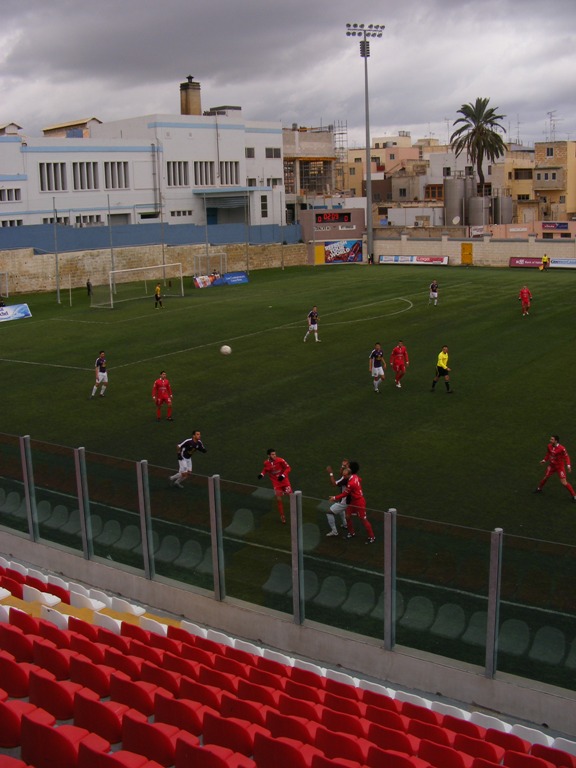
Malta is a three-hundred-square-kilometre speck in the Mediterranean Sea with a population only marginally bigger than the city of Bristol. It also has over fifty football clubs split into a four-division domestic league, three hundred days of sunshine a year and beer for as little as €1.50 a pint. Seriously, what's not to like?*

 * Except this wall, obviously.

 With just nineteen grounds and two grass pitches across the whole of the main island, matchdays are almost always double-headers, one ticket good for two fixtures with a quarter of an hour break in between.  The national stadium, Ta' Qali, is off a main road in the centre of the island, while Paola's Hibernians Ground and the Victor Tedesco Stadium in Hamrun are more easily accessible from Valletta's main bus station. The Tedesco is named after the engineer-cum-actor-turned-political fixer whose Saudi and Libyan oil interests funded Hamrun Spartans' decade-long hegemony over Malta's football league. Without a domestic honour since the end of the 1940s, the club won an average of two every season between 1982 and 1994, Tedesco splashing money on foreign talent like Tony Morley, once a European Cup winner with Aston Villa, and former England international Peter Barnes. The English players were given new suits and shoes, free transport and accommodation and four flights back to Britain every year. "I paid the best wages," Tedesco said. "I was also the manager. I selected the team in spite of the coach at times. He was really just my trainer."  In the end he overreached himself financially, almost bankrupting the club in the process. "I was too enthusiastic, too egotistic," he admitted. "It's a mistake to want only victory."


With Hamrun away to Hibernians in one of two Monday night games, first division sides St Andrews and Lija Athletic take up the mantle of home teams for the day, the opening fixture pitting St Andrews against midtable rivals Vittoriosa Stars. I'm accompanied by  Derek, a Newcastle fan who once travelled by train to Bari to watch them play in the Anglo-Italian Cup, and his girlfiend Jo, who's only ever seen  football on TV but thinks she might be able to make it until half-time.  There's an hour to spare until the two o'clock kick off and no-one else in the ticket window queue, so we follow a handwritten sign down a staircase towards 'Il-Bar', finding a squad of ex-Hamrun Liberty players drinking around a pool table. "You want to see more pictures?" one asks, taking us on an impromptu boardroom tour. "Bring your beer. Take photos," he tells us, gesturing towards plastic garden furniture, filing cabinets marked 'Archive', 'Stationery' and 'Tombola', pennants from West Bromwich Albion and Reading Schools, and a trophy collection stretching back fifty years.


The teams are jogging-out as we head into the ground. "St Andrews' end?" asks the turnstile operator. "Erm, yeah." Inside, a central VIP section appears to be mostly populated by the teams from the second game. A few dozen supporters are segregated either side, watched by four policemen wearing sunglasses and black gloves.  The warm-up consists of a couple of minutes spent tapping a ball around. "Yeah boys, come on," claps St Andrews' Malta Under-21 keeper Daniel Balzan, his gloves thudding against the whir of a generator behind his goal. "One-nil to Liverpool," someone says. "Rooney's not playing."


The first half is played at a pace as sedate as a Sicilian passagieta.  A defensive header goes vertically off a forehead, a midfielder slips over and sees a pass bounce away off his knee, and a forward tries a volley which smacks harmlessly off his own chin.  With St Andrews' Portuguese strikeforce of Guti Ribeiro and Valdo Alinho Goncalves left to fend for themselves up front, I count two shots in the opening twenty-five minutes, one of which lodges so high in the netting behind Balzan's goal that the ballboy only manages to dislodge it by throwing a backpack in the air. As soon as the whistle blows we join the queue for a beer, while a full quarter of the police presence retreats to the back of the stand to scoff a bag of Minstrels.  Neil, an English St Andrews fan, fills us in on the background of a team formerly managed by Ally Dawson, a Scottish international defender recently inducted into the Glasgow Rangers Hall of Fame.  "Because we're essentially from Sliema there's a lot of English spoken around the club, which most of the other sides dislike us for. There's a lot of us against the world at St Andrews."  "Especially Melita," his son concurs. "This place will be full when we play against them."  With clubs like Melita and St Andrews often just a mile apart, football rivalry inhabits the fault lines of Maltese society: language, politics and, occasionally, patron saints. "When the World Cup's on the island splits almost straight down the middle," says Neil, "half support England, the rest go for Italy."


The second half is a much more rollicking affair. Goncalves strikes the crossbar before Nicki Vella Petroni's volley crashes in to give St Andrews the lead. Vittoriosa, with Scottish forward Gary Muir wearing long-sleeves and gloves in thirteen-degree heat, gradually begin to find their way back into the game. "We have a habit of throwing away leads," Neil warns as the referee blows for a free kick. Balzan parries the shot straight to Ramon dos Santos, the Brazilian nudging in at the far post. "We've hit the crossbar twice and now it's 1-1," a St Andrews fan complains. Five Lija fans arrive for the next game, swigging Heineken out of paper cups. Their team are doing shuttle runs behind Vittoriosa's goal when Ryan Previ cracks a first-time shot past Jean Matthias Vella from twenty-five yards out. The Lija and St Patricks players applaud, Previ is mobbed and St Andrews fans jump in the air. "It's more interesting when you watch in person," Jo says on the bus back to Valletta. "Not bad," Derek agrees. "I've seen worse games in the Scottish first division."

Date: January 28th 2012.
Admission: €5 for two games.


If you're planning a football weekend in Malta, you can find a full list of fixtures here.  All-day bus tickets cost €2.60 for non-residents. For the Victor Tedesco Stadium, take any bus from Valletta towards Rabat and get off at the Mile End Road II stop just after Our Lady of the Miraculous Medal Church.  Bus routes and timetables are here and you'll find a great account of a day at Ta' Qali on the Tales From The Pigeon Stands blog.

Monday, 30 January 2012

Ground 203: The Regency Stadium, Northallerton Town

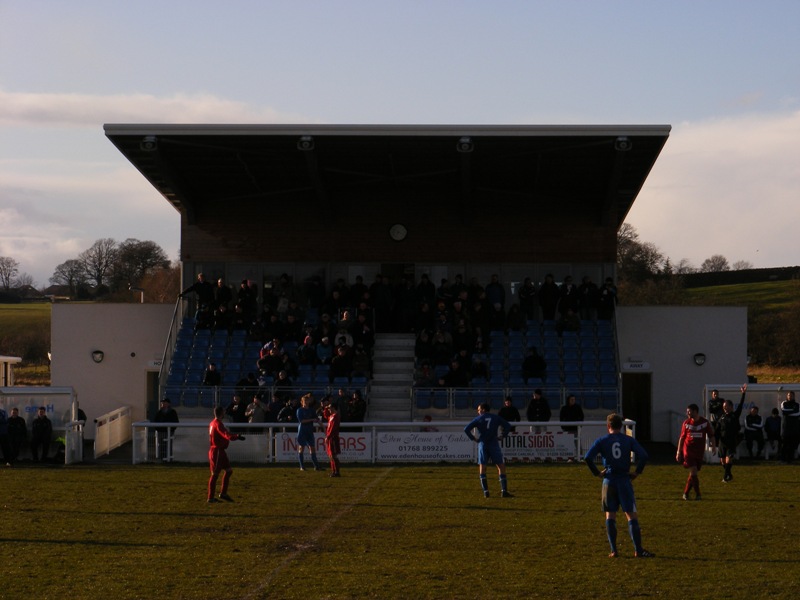
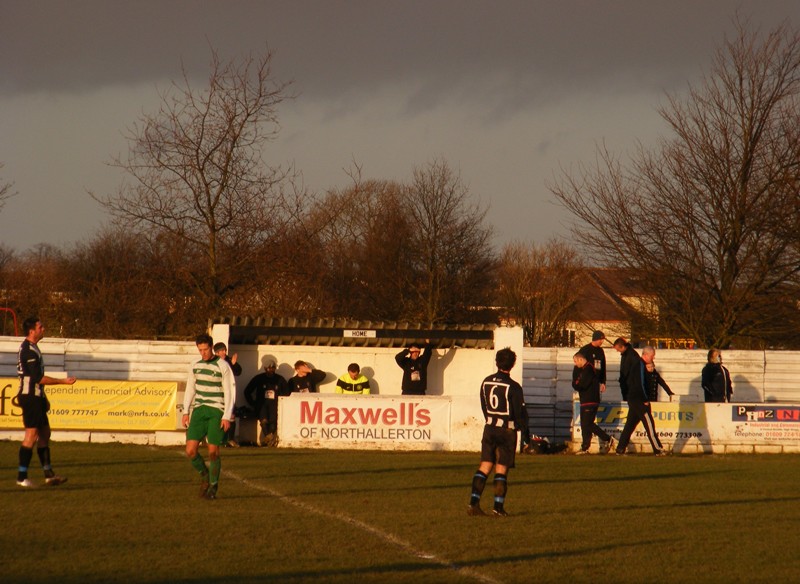
Almost two decades have elapsed since the boom and bust of Northallerton Town FC. Between 1992 and 1994 the North Yorkshire side blazed into the top six of the Northern League, the FA Trophy's last-16 and twice came within an away win of a place in the first round proper of the FA Cup. A crowd of 700 saw the visit of Farnborough Town; the Northern League Challenge Cup was sealed with a 2-0 win over Blyth Spartans. The trophy almost formed an epitaph to the club, the High Court winding it up over unpaid debts before its players had kicked another ball. Community support kept Town alive, but the Northern League's southern outpost has only seen four seasons of top-flight football since, the club more commonly having to content itself with less direct achievements such as the Dawson brothers moving to Nottingham Forest's youth teams and Darren Mowbray's elder sibling pulling Middlesbrough out of their post-relegation freefall.


The Grand Central service to Kings Cross departs from an underground Metro platform in Sunderland.  A portrait of Marilyn Monroe smiles from the doorways, Cluedo and Chess boards are printed on table tops and there's even free wi-fi if you can ever get it to connect (I couldn't in either direction).  Two Mackem girls on a London weekender swig back lemonade and white wine - "Eeeh, it's 14% this, y'kna!" - as we clatter through the Billy Elliot towns of the East Durham coal belt: brownfield, red brick, plastic litter. Northallerton is the third stop, an hour down the line and the thirtieth leg of the Northern League Tour James Williams began in August last year. "Not a good start," he texts as he enters the Station Hotel to find the landlord dressed in red and white stripes and a Sunderland pennant hanging from the bar.  Romanby's Golden Lion is just across the train tracks, a log-effect fire and Copper Dragon beers accompanying a window view of the village green, while the Regency Stadium itself is a few minutes further down Ainderby Road, past a Co-op food store, a war memorial and a pitch now belonging to Northallerton Juniors FC.  A sign outside the turnstile promises 'Open Tonight: Food',  wooden picnic tables are dotted along the side terracing, and the remnants of a wedding party watch kick-off from the clubhouse bar. "Can you get the team to sign my programme?" asks the bride.


Birtley's travelling ultras have come in the back of a player's van, outnumbered eleven to two by an equally vocal cluster of Northallerton fans standing behind the opposite goal. " We love you Birtley, we do" at one end of the pitch, "'Allerton, 'Allerton, 'Allerton" at the other. Four defeats in their last five games have left the home side clinging to the promotion pack like a banker to a million-pound bonus, and the bridesmaids have barely finished their chips when keeper Stephen Craggs brings Dan Smith down as the Birtley player prepares to tap in on goal. Craig Marron whacks the penalty into the top-right hand corner of the net. "He dived, ref," grumbles one home fan. "Rubbish," says a second. "Almost snapped him in bloody two."


Nobody contests the equaliser, Dan Clayton carrying the ball unchallenged through midfield before picking his spot as confidently as Marron. The gusting wind helps beat Birtley backwards and sends us in the direction of the clubhouse window, where, pints in hand, we watch the away side make the first of three strikes on the crossbar and Colin Anderson give Northallerton a thoroughly merited half-time lead. The black and whites shade most of the second half, too, Birtley's attacks finding nothing but the woodwork or, more commonly, Craig Winter's head. With the giant defender exuding calm like his father does controversy the home side don't seem in much danger of relinquishing their lead until Marron crosses for Dan Hepplewhite to nod in a leveller with just two minutes left of the ninety. "How much longer, referee?" a Northallerton fan shouts across the pitch. Long enough for a James Allsopp free-kick to find the corner of the net after two stepovers and three minutes of time added on. "Defeat from the jaws of victory" is the headline on a Northallerton forum; Birtley, undefeated since November 26th, are threatening to become promotion candidates themselves.


 Date: January 21st 2012
Admission: £4

Monday, 23 January 2012

Ground 202: San Mames, Athletic Club Bilbao

 This is Bilbao

From the seven streets which made up Don Diego López de Haro's original walled settlement, numbers have always mattered in Bilbao. 3/5/1894, for instance, the date of the city's first recorded football game, the Nervión reporting a 6-0 win for a team of expatriate British industrial workers against eleven Basques who'd picked up the sport while studying in England.  Or thirty-one, the number of major trophies Bilbao's football team has won since some of the losing players helped found Athletic Club four years later - the last a league and cup double notoriously sealed amid a 1984 street fight in the Santiago Bernabéu. There's zero for the number of seasons Spain's fourth most successful club has spent outside La Liga since the inception of a national league in 1929. Zero, too, for the non-Basques in Athletic's line-up since names like Martyn Veitch and Alejandro Smith featured in the team that defeated Espanyol in the 1911 final of the Copa del Rey. True, the Basque-only policy has been more generously applied in recent years, but 76% of  the respondents to an El Mundo poll declared they'd still rather see the club relegated than ever break it entirely. Con cantera y aficion, no hace falta importacion (with home-grown talent and local support, you don't need foreigners), as the popular saying goes.  The final number is of more personal relevance: 18, the years I've been waiting to see Bilbao since Newcastle United played there in November 1994.

 Inside the old San Mames

Cross the road and you're outside the new (due to open in August 2014).

"The Geordies' UEFA Cup visit is legendary in the city," FourFourTwo wrote eleven years later.  "Athletic fans recall in almost reverential tones the huge quantity of drink they shared with their visitors." "You couldn't buy a drink in the end," my dad remembers. "The Bilbao fans kept passing round these big plastic bottles of wine." "I was only four or five," says Athletic fan Miguel Arechavala. "but I remember looking out of my balcony and seeing Athletic and Newcastle fans holding a big Newcastle flag. It was going up and down the street; there were people everywhere." "Newcastle?" laugh three middle-aged supporters, making glugging gestures with their hands and throats. "This is a very famous game for us." A precipitant Mexican wave and a Jose Angel Ziganda goal eventually undid Kevin Keegan's side. Typically, it would be the only European trip I missed out on in the four years that separated the 5-0 defeat of Royal Antwerp from a Cup Winners' Cup loss at Partizan Belgrade. Now, as Athletic prepare to move into a a new 55,500 capacity stadium, time is finally running out at the San Mamés, the club's home since 1913 and one of the earliest purpose-built grounds in Spain.

 Matchday in the Old Town

It's half past five on Saturday evening when La Catedral's  gated ticket windows finally snap open. Ahead of us in the queue are Dominic, an Australian Celtic supporter, and a Fulham fan from Italy who refuses to pay €36 for a seat behind the goal. Football tickets aren't the only things that end up costing more than we expected: the average price of  una caña (or "baby beer" if you're English) in the Casco Viejo bars is €2. Tapas comes extra. Despite the high prices, in footballing terms Bilbao is one of the best value destinations in Spain, with virtually every bar in the city displaying its allegiance to Athletic and the plethora of clubs within easy reach of the Metro network - including Arenas Club de Getxo, Copa del Rey winners in 1919 and one of the ten founding members of La Liga - making it possible to take in five or six matches over the course of a typical weekend.

 Aupa Athletic!

Matchday sees red and white flags draped above doorways, signalling socio drinking haunts and bars that are televising the game. The giant Athletic badge on the side of the San Mames is a constant beacon as we move among the half-empty bars on Licenciado Poza, where Newcastle and Bilbao fans thronged in 1994. "It's quiet today," says Jamie Rae, a St Johnstone supporter whose affection for red and white stripes began when he adopted Sunderland as his English team, "but it's much busier for Saturday games." Things don't begin to get crowded until we're inside the stadium itself, squeezing onto a step behind the goal the home side are attacking as the Himno Athletic Club de Bilbao formally announces the entrance of the teams.


The ninety minutes that follow are unexpectedly one-sided, Levante unable to find an answer to Athletic's direct attacking style. A tenth-minute corner finds Fernando Amorebiete's head to give Bilbao the lead, and with Levante's midfield in retreat José Barkero and Arouna Koné are left to forage up front on their own.  Koné's shot into the side netting betrays the presence of four or five away fans, a handful of confetti blowing forlornly across the pitch, but when right-midfielder Óscar de Marcos - "Bielsa was playing him left-back until he decided the left-back was good enough to play there himself,"  Jamie tells us - shimmies past Javier Farinós, Fernando Llorente nods in the resulting cross and the game is over as a contest with five minutes of the half still to play. The home fans respond to each goal with cries of "Athletic! Athletic!",  the middle vowel as long as the gaps in the centre of Levante's defence.  Two-nil up, Bilbao drop the pace, Gaizka Toquero charging round the pitch to roars of acclaim from the crowd after replacing Llorente. In the 90th minute another substitute, the former Liverpool junior Mikel San José, heads a third from a corner after Levante's Juanfran is sent off for picking up a second yellow card.  For a neutral, the only slight disappointment is the San Mames atmosphere, which, despite the noise that greets each goal, more often feels as sanitised as the big grounds of the English Premier League. "I won't lie to you," says Miguel, "the noise today was normal. Of course, it's different when we play Real Madrid."

Admission: €36
Date: 15th January 2011

Arthur Pentland and the Founding of Athletic Club Bilbao

Bilbao fans readily acknowledge and celebrate the English influence on their club, but the story that Athletic were founded by a County Durham shipyard worker who based the red and white strips on Sunderland AFC seems to rest on one or two British newspaper references, notably this 2004 example from the pages of The Daily Telegraph:

Like many of his colleagues, a 19th Century stevedore called Arthur Pentland did a shipbuilding stint in Bilbao. In between thumping home rivets, Arthur co-founded Athletic Bilbao and ordered their costumes. The Basques not only played in a replica red-and-white-striped kit, but loaned a spare set of vests to the emerging Atletico Madrid.

Athletic's own records, as summarised here, contain no reference to a "19th century stevedore" and the only other printed record of the name I've been able to find is a 1969 article from the archives of El Mundo Deportivo which mentions "the greatest successes of the club forty years ago under the direction of Arthur Pentland". Athletic did win a pair of La Liga titles and five domestic cups in the 1920s and 1930s under the guidance of an English coach, but  Fred Pentland was born in Wolverhampton  and was playing junior football in Birmingham at the time 'Arthur' was "thumping home rivets" in the Bilbao dockyards. Workers from the banks of the Wear and Solent may have taken part in the 1894 game, and British expatriates had a hand in the formation of one of the clubs which eventually became the modern Athletic Club Bilbao, but in the absence of any solid evidence to the contrary 'Arthur Pentland' himself appears to be no more than historical invention, an English journalist mixing up the story of 1894 with a surname borrowed from thirty years later. In any case, by 2007 the same writer was attributing the club's origins to nameless "British workers who left Sunderland and Southampton to work in the city's steel and shipbuilding industries", while Sunderland fans have themselves debunked the Pentland story here.


As for the costumes, Athletic played in blue and white halves until at least 1910, seven years after "the emerging Atletico Madrid" were founded as as a youth branch of the Bilbao team by Basque students in the capital.  A more prosaic explanation for the two clubs switching to red and white stripes in 1911 is that the material was simply cheaper to buy, though one competing theory is of a Madrid director (or sometimes Basque student) being sent  on a shopping trip for Blackburn shirts and returning home from London with Southampton ones instead.  Whatever the truth, ascribing the origins of Athletic Club Bilbao to either Sunderland or Southampton remains an exercise in wishful thinking rather than historical fact.

Sunday, 8 January 2012

Ground 201: Gillford Park Stadium, Gillford Park.

What could be better than football and beer? Only a Saturday train ride from Newcastle to Carlisle taking in almost fifty of the finest real ale pubs in Cumbria and Northumberland and ninety minutes of action in the world's second oldest football league. A simple plan until we made it to the centre of Britain, when it unravelled faster than Liverpool's defence of Luis Suarez.


It's eighteen minutes past opening time but the first pub on our list is shut for another hour. While the lights are on in the place next door, we're left staring at Sky Sports News and beer pumps until the barman eventually ambles in. "We don't usually allow food in here, you know," he growls as James tucks in to a minced beef pie and Carling Extra Cold. "It's my breakfast, sorry."* "I don't care what it is," he snaps, which is exactly the kind of response you should expect for ordering a pint of fizzy in a pub that sells real ale.

Back on the train the football traffic is all for Carlisle United's home game with Orient. We take a right outside the station, give a crowded Wetherspoons and what I'm fairly certain is the worst pub in the world a miss, sink two pints of Jennings and a Newcastle Brown Ale in the Woodrow Wilson, then walk twenty-five minutes to the ground in pouring rain (or, as the BBC calls it, "Dry with sunny periods."). A concrete track along the West Coast Main Line brings us to the Gillford Park Stadium and a British Rail social club whose only occupant is a barmaid with her feet up in front of the darts.


There's a very good reason why. In 2005 just seven men - including co-founders Mike Linden, Geoff Andrews and Steve Skinner, a  former first-team midfielder at both Gretna and Carlisle - turned out for Gillford Park's first training session.  Within four years they'd progressed through the three divisions of the Northern Football Alliance; another twelve months and the Northern League's youngest club sat midtable in Division Two and had qualified for the extra-preliminary round of the FA Cup.  With a 25-year lease on a ground capable of holding 4,000 spectators and new Conference-standard floodlights installed, the management team of Skinner and Stuart Bell should have spent the summer laying plans for another promotion bid. Instead, rumours that landlords the Carlisle and District Railway Club had been seeking more lucrative tenants were accompanied by a sudden raft of health and safety issues which saw the team locked out of the stadium and forced to play their opening nineteen games of the season away from home. An interim injunction finally allowed the visit of Crook Town in the first week of March, but court proceedings are still ongoing with a final hearing not expected for another four months. "At least they should finish the season," the football club's legal adviser Richard Bloomfield told the Christmas 2011 edition of the magazine Northern Ventures Northern Gains.


On the pitch, at least, events have reverted to plan, Gillford currently four points off the Division Two promotion places with up to six games in hand on the teams above them.  Birtley Town have been almost equally troubled in recent seasons but sit a point ahead of the home side in sixth under the astute management of Scott Oliver, Barry Fleming and Paul Brown, their squad of promising young players - including 17-goal top scorer Dan Smart - supplemented by experienced heads such as former Esh Winning and Ryton midfielder Craig Marron.

Smart doesn't make the journey but Andy manages a head count of forty spectators including five Birtley Ultras who've turned up by car. "Nothing much to shout about this half," one says at the end of a forty-five minutes in which Gillford Park could justifiably have been three or four goals ahead. Somehow the scores are level, an early Ryan Errington goal - "Three yards offside" think Birtley's bench - cancelled out when John Martin's sliding effort just about crosses the line. "Just let it go, lads. It's gone now," says Gillford's keeper. "You can't tell me that was in," his manager tells the referee as the teams walk off for half time.


Martin scores again with the first attack of the second half, and when an attempted clearance strikes the underside of Reece Darwent's boot Birtley's ultras are doing a four-man Poznan and their side are 3-1 ahead. David Wallace heads Gillford back into the game on the hour, then three goals in little more than a minute see equalisers from Mike Reed and Marc Shiel, Dan Smith's big toe giving Birtley the briefest of leads. "We're too susceptible to crosses so you've got to stop them coming in," Fleming says as Shiel volleys in his 17th league goal of the season. "We love you Birtley, we do" and "Scotty Oliver's green and white army" the ultras sing, before asking "What's it like to hear a crowd?"


Straight out when the whistle blows, we scramble aboard the 5.28 from Carlisle, getting off at Haydon Bridge to find a pub with darkened windows and another next door where the conversation veers between the migratory patterns of fish in the Falkland Islands to Nicolas Anelka's wages at crack Chinese outfit 'Shanghai Rovers'.  "Four hundred thousand a week that Shanghai Rovers are paying Drogba and Nico whatchamacallit. That's about twenty million a year." "Aye, we'd all take the same though, wouldn't we?" "I divvent kna, they don't mess around. I saw on the telly they hung 330 people in a week. One mistake there and you're gone."  The last stop is Corbridge, where Paddy McGuinness' face leers out of a TV screen and a private party in the back room are wrapping each other in toilet roll to make snowmen.  "Pint of Deuchars, please...actually, you'd better make that two."


Date: January 7th 2012
Admission: £4

* He's from Durham. It's absolutely normal. 

Friday, 6 January 2012

Ground 200: Strathclyde Homes Stadium, Dumbarton

Dumbarton or Airdrie? Airdrie or Dumbarton? "Airdrie are playing Albion Rovers in a derby, they're near the top of the league and Hughie Gallacher used to play for them." "Yeah, but Dumbarton's ground is right underneath a big rock." Right, we'll go there."


"Dumbarton is for the most part a brutal concrete sprawl, fulfilling every last hellish cliche about postwar planning and architecture" says my 2004 copy of the Rough Guide to Britain, though all that suggests is that the writer's never been to Sunderland Central Station. I kept my head towards the pavement between Dumbarton East and The Counting House pub, where haggis, neeps and tatties with a pint of Belhaven Best came to under £6, and old men nursed cans of Irn Bru through the dull first hour of Hibernian against Hearts, their eyes never leaving the screen.  Between them, the Edinburgh sides were responsible for two of the five Scottish Cup final defeats Dumbarton suffered between 1881 and 1897. Cup winners for the only time in 1883, when they saw off local rivals Vale of Leven in a replay, the club had more success in the newly-formed Scottish Football League, sharing the championship trophy with Rangers in 1891 and winning it outright the following year when they beat Celtic into second place and Rangers by an aggregate scoreline of nine goals to one. Professionalism eventually proved a more difficult opponent, Dumbarton's amateurs resigning their place in the league after a return of six points from eighteen games left them bottom of Division Two in May 1897. By the time they rejoined nine years later the club's glories had already been lost to a sepia age. In 2000, fifteen years since it hosted a top-flight game, Boghead Park, the scene of what remains the record league defeat in Rangers' history, was abandoned for housing and a new 2,025-capacity stadium built between the 17th century castle, the former site of a whisky distillery and the dormant shipyards of the River Leven.


They're a friendly bunch at the Strathclyde Homes Stadium. "These two lads are up from Newcastle for the game," announces the man selling tickets for the club's half time draw. "All the way from Newcastle," he grins. "Saturday's a fitba day. If we don't have a game I'll go and watch Partick or Queens Park, but there are Celtic and Rangers fans in Dumbarton who've never even been here." "Hope you enjoy yourselves, lads. A Scottish New Year welcome," says another, shaking my hand as we queue at the bar. A programme seller sets up out of a carboard box by the fire escape, the surrounding walls adorned with flags from Division Two championships, team shirts and framed photographs featuring Graeme Sharp, Ian Wallace and Murdo MacLeod, youth team graduates who went on to Everton, Celtic, Borussia Dortmund and Brian Clough's Nottingham Forest. A team shot from 1983 includes Albert Craig, less heralded on the pitch but later to make ten appearances for Newcastle United and one at Glasgow Sheriff Court, where he admitted helping himself to £40,000 from a Royal Mail sorting office and was sentenced to twelve months in jail.


Six hundred fans turn out for Dumbarton and Arbroath's third meeting of the season, the visitors winning the previous two by four goals to three to start the year second in the table behind Cowdenbeath. "No-one likes us, we don't care," the Arbroath fans sing, using a Klaxon horn to repeatedly reinforce their point.  There isn't much else dividing the teams until the 20th minute when James Creaney's nine-iron cross finds Bryan Prunty's forehead to put Dumbarton 1-0 in front. Not that single goal deficits faze three-cap veterans of Berti Vogts' Scotland. Brian Kerr - an international midfielder during his time on the books of Newcastle and Motherwell - plays a ball from halfway, Steven Dorris outpacing Alan Lithgow before slipping the ball under Stephen Grindlay to quickly level the scores. When a misdirected header falls to Josh Falkingham's right foot the home side are 2-1 down twelve minutes after taking the lead. "Can you hear Dumbarton sing?" gloat the travelling fans.


 Made to chase the game on a rain-sodden pitch, the home side's wayward passing creates as many chances for the opposition as it does for themselves. Grindlay looks vulnerable whenever the ball's in the air but makes two excellent saves as Arbroath squander opportunities to put the game out of reach. There are five minutes left to play when Lithgow somehow squeezes an equalising goal through two Arbroath players and keeper Darren Hill, the ball finally deflecting in off a defender's fist.  In time added on Pat Walker - brought on as a 79th minute substitute - breaks clear, his shot rebounding into the net off Hill's left hand post. The silence is all at the far end of the stand.


"I never thought we'd turn that around at half time," a Dumbarton fan smiles on the walk to the Stags Head pub. "Me neither," says his mate. "Fucking great way to start the year!"

Date: January 2nd 2012
Admission: £12

You can see video highlights of the game here as well as cinefilm footage of Boghead from 1980.  If you don't like bagpipes, it's best to turn the sound down now.