Saturday, 13 August 2011

Ground 179: Swans Recreation Ground, Newcastle East End

The original Newcastle East End Football Club was founded on the occasion of Stanley Cricket Club’s annual general meeting, 15th of November 1881. The members, whose club was named after the vacant plot of land they played on near Stanley Street in Byker, voted in favour of forming a football team. Eleven days later they played their first game, beating Elswick Leather Works 2nd XI by five goals to nil.

After changing both their name – the initial choice had caused the club to be confused with two County Durham teams, Stanley Nops and Stanley Albion - and home ground, East End settled near a railway junction on the Chillingham Road at Heaton. In November 1883, while still based in Byker, they drew the first of their derby games against Newcastle West End. Two years later, they defeated their city rivals in a semi-final replay on their way to lifting the Northumberland Senior Cup. In 1887 East End made their first appearance in the FA Cup, losing 3-2 after extra-time to South Bank of Middlesbrough.


Both East and West participated in the opening Northern League season, a crowd of 1,500 turning up at Heaton for East End’s first home game against Darlington on September 7th 1889. A week later West End won the city derby 2-0 in front of a 4,000 crowd at their home ground, St James’ Park. West End finished runners-up on goal difference to Darlington St Augustine’s with East End two places behind.

West’s ascendancy wouldn’t last for long. In February 1890, East End became the first of the city’s clubs to turn professional, the board of directors issuing 2,000 public shares and electing Adam Gilchrist as their first chairman. The eighty-two men and one woman who bought ten shilling shares in the club listed occupations including wine merchant, hosier, bookbinder, schoolmaster, traveller, milkman and spinster. Despite a disappointing second season for both clubs – East finishing one place above West in sixth as Middlesbrough Ironopolis won the first of their three successive titles – the tide had turned in favour of the Heaton-based club. East End finished fourth behind Ironopolis, Middlesbrough and Sheffield United in 1892, lost 2-1 away to Nottingham Forest in the First Round of the FA Cup and beat West End no fewer than five times, including a 7-1 thrashing at Chillingham Road. In April 1892, struggling on the pitch and beset by financial problems off it, two West End committee members offered East End “the West End ground for the rest of the lease and £100” to take over the running of the club. Although East End Wednesday continued for a time at Chillingham Road, Newcastle’s two biggest clubs became one on May 8th 1892, East End moving their team and main stand to St James’ Park. The opening game at their new stadium was a friendly against Celtic, the visitors winning 1-0 in front of 6,000 fans.


Rebuffed in their attempts to join the top flight of the Football League – the club polled just one vote at a meeting of First Division clubs and rejected the offer of a place in Division Two – East End played one final season in what was now a six-team Northern League, finishing eight points behind runaway champions Middlesbrough Ironopolis. Gates remained stubbornly low, prompting the club’s chairman to tell the local press: “If the public want a professional team they must be prepared to pay for it”. In an effort to widen the club’s appeal a public meeting was called to discuss a change of name, a near unanimous vote opting in favour of Newcastle United. The side turned out for the first time under its new name at Christmas 1892 in a home defeat to Middlesbrough seen by 2,500 fans. On September 6th 1895, the legal title was finally amended: East End was no more.

A century on, as Kevin Keegan’s side prepared for their ill-fated assault on the club’s first title since 1927, Charlie and Kelly Scott reformed Newcastle East End as a grassroots football club with just a single junior team. The club now has twenty different sides and four hundred members, an FA Charter Standard award testament to the strength of its work in the local community.


The senior side ended last season tenth in Division One of the Northern Football Alliance, one place ahead of Morpeth Sporting Club. Morpeth, formed as recently as 2009 following the amalgamation of FC Morpeth and Morpeth Town Juniors, finished fifth and won the Northumberland Minor Cup in their first full season but, like East End, have more recently established themselves among the division’s more nondescript teams.


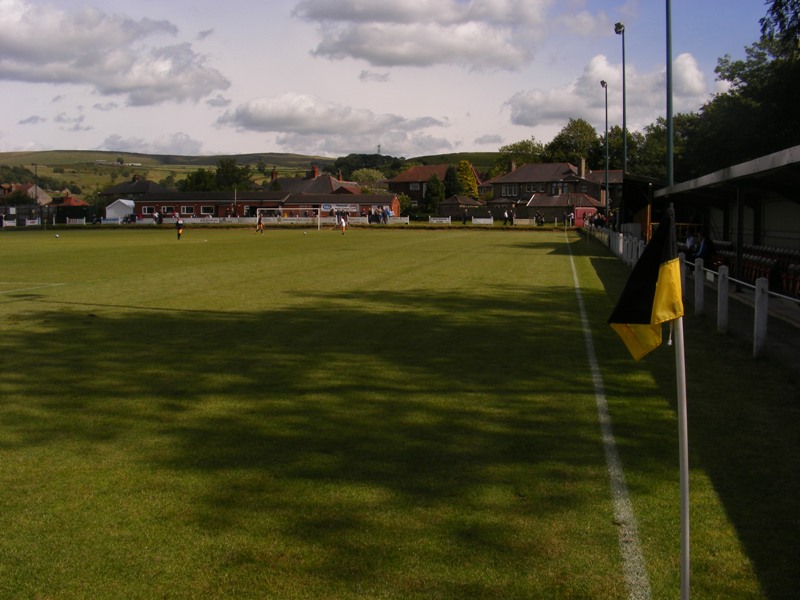
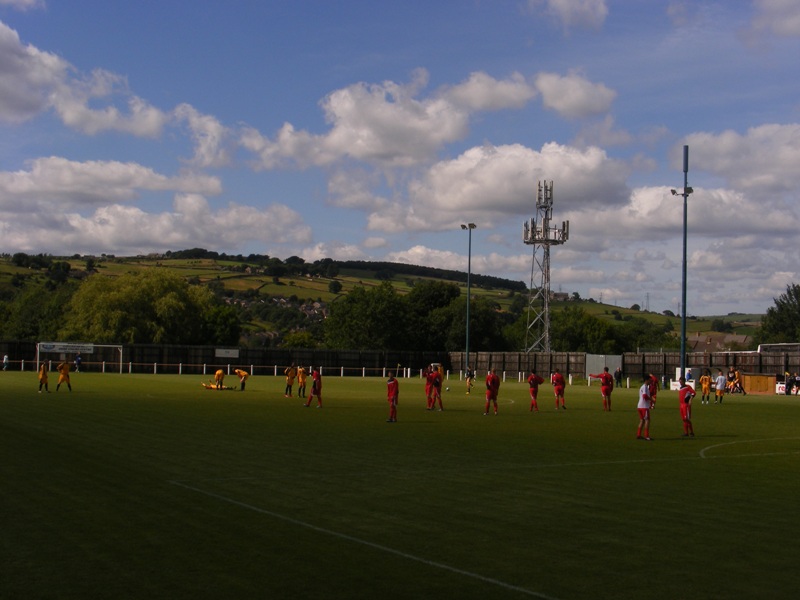
It’s an overcast, mid-August day and the blackberry pickers are out along the Shields Road as the Northern Alliance 2011-12 season gets underway. The two managers give their final instructions at separate ends of the pitch – “Keep talking to each other” and “Massive game for us” – while a home defender nips to the touchline to take a last minute piss through the metal perimeter fence. East End see a shot hooked off the line and another clear the bar by mere inches in the opening five minutes. With Jamie Richardson dominant down the right and Paul Blakey cleverly linking the play, the home side have the better of the opening quarter, Morpeth’s attempts to find their two big forwards invariably ending in raised offside flags until the 24th minute when Chris Musgrave bursts through two challenges and is clipped as he drags his shot wide of the post. Wayne Buglass gets a hand to Rob Haney’s penalty but can only push it into the corner of the net.

East End run and tackle hard but stumble over the final ball, while Haney goes close again in the 40th minute, the home side losing their shape after referee Michael Shearer awards a disputed free kick. An increasingly ill-tempered second half is largely devoid of goalmouth action until a Dan Grey mistake on the hour leaves Haney free behind the defence. Buglass saves the first shot only for Michael Starkie to follow up with a first time shot low into the corner of the net.


Buglass makes two good saves and watches a shot smash against his crossbar before his side are reduced to ten men following a studs up challenge on the edge of the box with ten minutes left to play. East End lose their last remaining vestiges of discipline and the third goal Morpeth have been threatening finally arrives with almost the very last kick of the game.

Admission: Free
Date: 13th August 2011

Saturday, 6 August 2011

Ground 178: Metcalfe Park, Wolviston.

Rivulets of rain stream down the windscreen, puddles widen, bunting sags miserably against the front of the village shop. ‘Welcome to Wolviston – Please Drive Carefully’ says the sign at the start of the village. “There’s nothing around here that looks like a football pitch,” we mutter, waving mobile phones in the air as we try to pick up a signal.


It takes a combination of Google maps, a cricket sight screen and three men under golf umbrellas helps us find Metcalfe Park just in time to see the two teams enter through a gate in the perimeter fence. The ground is next to a cricket club and garden centre, south of Wynyard Hall, west of the A19. The early arrivals in the crowd of 14 (excluding substitutes and club officials) hug the back row of the main stand, the only artificial cover outside of the two dugouts. We choose the shelter of a conifer hedge on the opposite side of the pitch, which keeps us semi-dry until the rain begins to cascade through the branches on the stroke of half time.

There’s been a football team in Wolviston since 1910, though the Wearside League – which the club joined in 1988 – remains the highest level they’ve ever reached. Three-time winners of the Sunderland Shipowners’ Cup since 2001, Wolviston ended the 2006-2007 season behind only Birtley Town and Whitehaven Amateurs (both since promoted to the Northern League), but have recently slipped back into mid-table, finishing thirteenth of the league’s twenty member clubs twice in the last three years.


“Patience, lads. If we ping the ball around here they won’t be able to live with us,” Wolviston manager Martin Summersgill tells his team before the game gets underway. They do their best to follow instructions, playing most of the early football with their visitors from Sunderland, Ashbrooke Belford House, content to strike long clearances towards their lone centre forward, the 37-year-old Stephen Dickinson. The two teams put more pressure on the referee than on either goal until the 35th minute, when the Wolviston defence fails to clear a free kick and Dickinson sidefoots his first goal of the afternoon past the unsighted home goalkeeper.

The rain gets heavier and thunder rumbles over the pitch. “Are there many pools on the pitch?” someone asks over the cricket club fence. “I don’t know but there are plenty on my trousers,” comes back the reply. An equally ominous sign is the freedom being afforded to Wolviston’s Anthony Brown, the right-back finally managing to translate time and space into an accurate cross, Ryan Hebb turning the ball in at the far post for the equalising goal. When the whistle blows we scurry back to the car, missing the entertainment provided by a side-of-pitch lightning show. “You can hardly see out there, man. Forks of lightning and everything!” an Ashbrooke player exclaims when he’s substituted after the break.


Wolviston undo their recovery work with two unforced errors in the opening five minutes of the second half, keeper Daniel Jeffry undergoing the kind of judgement malfunction more commonly associated with an England goalkeeper at Wembley. First, he races out and completely misses a through ball, leaving Dickinson with a tap-in second goal. A miskick from home captain Shaun Gregory lays on the third, Jeffry remaining static in the centre of his goal as Dickinson slams a shot in next to the right-hand post. Prompted by substitutes Matt Garbutt and ex-Hartlepool junior Christian Selby, Wolviston spend the remainder of the game in the Ashbrooke half, but a mixture of stout defending, ill-fortune and poor finishing keeps the score at 3-1, a late red card reducing the home team to ten men.

Driving home we hear Newcastle United’s game with Fiorentina has been called off after 63 minutes, heavy rain making the pitch unplayable. They could learn a thing or two from the Wearside League.

Admission: £2
Date: August 6th 2011

Tuesday, 2 August 2011

Football Art: The United Trinity

"Who are they?" asks the young boy in a Mancunian accent, coming out of the Megastore with two bulging carrier bags and a newly bought shirt, Rooney 10 printed on the back. "They're famous United players from the 1960s," his dad replies, pointing his finger through a gap in the wire fence. "Oh," he says, his voice betraying a rapid drop in interest. "The Trinity," his father goes on, unheard. "Best, Charlton and Law..."

Unveiled in 2008, forty years to the day from Manchester United's first European Cup win, the bronze statues were deliberately placed directly opposite the elevated scupture of Sir Matt Busby, facing the Megastore entrance and the glass facade of Old Trafford's East Stand. Designed by Philip Jackson - who also did Busby and the statue of Bobby Moore outside the new Wembley stadium - Law is at the centre, frozen post-goal, right arm and index finger held aloft. Best and Charlton form a photograph huddle, arms draped around the scorer, socks pulled up to the kneecaps and a leather ball placed casually in Charlton's hand like a scroll in the palm of an ancient Greek orator.

For Charlton, present at the unveiling along with the other surviving members of the 1968 team, the accolade was "a fantastic compliment...one of the greatest things that's ever happened to me". "To just think as the years have gone, starting as a young boy of 15 coming down from Scotland," recalled Law, "and many, many years later you've got a statue outside Manchester United's ground." "George was always telling me," said his sister, "when I'm gone they'll forget the rubbish and I'll be remembered for the football."

Always.

Sunday, 31 July 2011

Ground 177: Grimshaw Park, Prestwich Heys

Three miles north of Manchester city centre and five miles south of Bury, Prestwich is home to Victoria Wood and Heaton Park, Britain’s second biggest Jewish community and Prestwich Heys AFC, a football club formed the same year Neville Chamberlain came back from Munich promising “peace in our time”.

The young side won its first major honour, the Woodward Shield, as Allied troops prepared to storm the beaches of Sicily. By the outset of the 1970s Heys had matured into one of the top non-league sides in the country, reaching the last eight of the FA Amateur Cup in 1969-70 before making a clean sweep of all four Lancashire Combination League trophies the following year. But despite being founder members of the North-West Counties League in 1982, a shortage of financial backing meant the club was already on the wane, dropping down to the Manchester Football League in 1986 after their ground failed to meet the North-West Counties’ grading requirements. A revival in the mid-2000s saw Heys win three successive titles and obtain planning permission to install a set of floodlights at their Grimshaw Park home before the tragic death of manager, chairman and former player Adie Moran in the summer of 2007. Last season saw the club record a disappointing twelfth-place finish, twenty-nine points adrift of champions Manchester Gregorians.

Visitors St Helens Town were also among the North-West Counties’ founder members, though unlike Prestwich they’ve remained there ever since, ending last season seventeenth of the twenty-two Premier Division sides. FA Vase winners in 1987, they had earlier produced John Connelly, a title winner with Burnley in 1960, and Bill Foulkes, a European and FA Cup winner and four-time champion of England during his 563 appearances with Manchester United. Bert Trautmann, the ex-German paratrooper who went on to lift an FA Cup and the Football Writers’ Player of the Year while at Manchester City, started his post-war career with the club after coming out of a nearby prisoner-of-war camp in 1948. Like Foulkes, Trautmann remains an honourary president of the club.

The players are out sunbathing when I arrive at Grimshaw Park, after a ten-minute walk from the Metrolink stop at Besses o’th’Barn. Pylon cables hang above the side of the pitch and ‘Welcome to Prestwich Heys sponsored by Grimshaw Vauxhall’ is painted on the side of the portakabin from which the sides will later emerge. Two static caravans house a small bar and tea hut counter and a pair of brick dugouts marked Home and Away are placed on the side of the pitch furthest from the two-way buzz of traffic coming from the neighbouring M60 motorway. Seating is on the grass or a line of plastic chairs placed in front of the bar. The only cover is from the sun, the concrete perimeter fence providing a few metres of shade in the weeds behind the goal where the six travelling fans have tied up their flags.

The two sides are evenly matched for the first half of the game. “We’ve started flat again,” the visiting keeper tells the crowd during an early break in play. “No urgency, just strolling around.” With Kyle Greaves' pace causing the St Helens' left-back untold problems, both sides have their chances to score before the visiting team break the deadlock immediately before the half-time whistle. The Heys keeper pushes a fierce, rising shot away but Karl Brown is on hand to force the ball over the line.

Buoyed by the goal, Saints squeeze the home side at both ends of the pitch in the second half, their offside trap restricting the home attack to long-range shots while their own forwards plant two headers wide and see the impressive Prestwich keeper palm another effort over the bar. On the single occasion Heys break through on goal skipper Matt Morris sidefoots wide with only the keeper to beat. A late rally sees the home side have a shot cleared and another strike the top of the bar, but an Andy Ledger goal in the 85th minute puts a more accurate sheen on the overall balance of play.

Date: 30th July 2011
Admission: £1 (plus the same again for an excellent minced beef pie at half time).

Saturday, 30 July 2011

Ground 176: Church Lane, New Mills AFC

One hundred and twenty-five years after the first game of football was organised in the High Peak, New Mills AFC finally made it to a Step Four league, winning the Vodkat Premier by an eleven-point margin after two second-placed finishes in the previous two seasons. But then geography intervened. Enfield 1893, champions of the Essex Senior League, were ruled out of promotion by an Isthmian League ground inspector. In the reshuffle which followed, Ossett Albion, newly relegated from the Evostik North, were reprieved on a points-per-game formula, filling the space earmarked for New Mills. One failed appeal later, the Millers were placed in Division One South, leaving them with trips to Grantham Town, Market Drayton, Romulus and Sheffield FC rather than any of the six clubs from Greater Manchester who play in Division One North, including one, Woodley Sports, who even share their SK postcode.

My own journey was a bit less complicated. A half-hour train ride from Manchester Piccadilly brought me to New Mills Central, from which the Church Lane ground is an easy 10-15 minute stroll: up the steep Station Bank, right at the junction by the Heritage Centre, over the River Goyt bridge, left past the Co-Op and opposite St George’s Church, passing two pubs and a Cantonese along the way. There’s hard standing on two sides of the immaculately tended pitch and a covered stand down the length of one touchline. The clubhouse, bar and tea hut are behind the goal nearest the entrance, picnic tables arranged on a rise, grassy hills and chimney-tops peering over the wooden perimeter fence.

I take up a seat next to three men in yellow and black scarves. “£6.50 for a friendly?” says one. “It’s not right. I’ve told them it’s not. I had the grandkids with me but I wasn’t paying £3 for a game like this. Sent them home, and that’s £6 you’ve lost there.” The few dozen fans who’ve made the journey over the border from Bala Town gather at the entrance to the bar as their team are put through their paces in the afternoon sun.

The training session pays off as the visitors pin New Mills to their own goalline for most of the first half. Lee Hunt has the game’s opening chance, Procter pushing his shot back out and the Millers’ defence – which includes Wes Brown’s brother Clive – scrambling the ball away. Shortly afterwards an effort from Stuart Jones strikes against the underside of the bar and spins away from goal, Procter clinging to his line like Ed Miliband faced with a TV camera. “Tell you what,” says one of the bumblebees to my right, “this lot are going nowhere. Not a chance. We’re gonna get battered. Straight back down.” “Crap crowd too,” mutters another voice. “It’s cos they’re robbing bastards. If you’re paying £6.50 for a friendly you should be seeing top players not trialists.” “It’s something we’ll look at next year,” says the woman selling raffle tickets, pausing on her way around the pitch to see Bala screw another two chances narrowly wide of Procter’s right hand post.

It takes forty-three minutes for the Millers to seriously threaten Terry McCormick’s goal, Danny Pringle meeting a cross from the right with a volley that gives the home side an entirely undeserved lead. “Counter attack,” says a man to my left, sagely. If the first goal was a surprise the second is astonishing, the flying head of Matt Berkeley touching a cross past McCormick. “Mark the runners, stop the crosses. It’s not difficult, is it?” the goalkeeper moans.

Two down with quarter of an hour to play, the Welsh Premier League side flick on the turbo switch, Chris Mason finally drawing Procter off his line before slipping the ball under the goalkeeper's body. Mark Jones levels from close range but the keeper responds with three fast saves before a cross bobbles off a defender and Lee Hunt slams in the winner via a post, the crossbar and a bounce on the line.

Date: July 23rd 2011
Admission: £6.50

Sunday, 17 July 2011

Ground 175: Moss Lane, Altrincham

It’s 30 minutes on Manchester’s Metrolink from Victoria Station to Altrincham, an affluent market town eight miles south of the city centre which is home to a 24-hour Tesco and one of the most famous names in English non-league football. Founder members of the Conference in 1979, Altrincham were the Liverpool of the amateur game, winning back-to-back titles at the start of the 1980s, two FA Trophies in a decade and famously defeating Birmingham City (and a young David Seaman) 2-1 in the 1986 FA Cup third round, the last time a top-flight side lost to non-league opposition.

That aside, they can’t have seen many day-glo yellow boots at Moss Lane, let alone a pair adorning the feet of a £90,000 a week international footballer. But just two months after Manchester City claimed their first trophy in thirty-five years Craig Bellamy, once of Newcastle United, Liverpool and Celtic, is doing shuttle runs between the Popular Side and Carole Nash Family Stand while England Under-21 internationals Nedum Onuoha and Michael Johnson limber up nearby and the rest of the first team prepare to take on Mexico’s Club America in the drier and slightly more exotic climes of San Francisco.

With sixteen FA Cup wins over Football League sides Altrincham are a well-renowned nuisance to higher ranked teams. Helped along by some lackadaisical defending from Courtney Meppen-Walter, they take the lead two minutes into the game. City concede a penalty with virtually the first touch an Altrincham player has on the ball and Damian Reeves smacks his kick through the goalkeeper’s arms. “Someone YouTube that one later,” says an Altrincham fan from the top of the stand as Meppen-Walker looks apologetically at the ground.

The game is played at a training ground pace, the part-timers content to harry City’s midfield – which includes Johnson, Premier League substitute Abdul Razak and Israel international Gai Assulin – in possession and Bellamy bustling around tirelessly upfront alongside Joan Angel Roman, an 18-year-old attacking midfielder bought from Espanyol. Their work goes unrewarded until the 37th minute, when Bellamy works a four-man single touch passing move and Roman shoots low into the Altrincham net. Eight minutes later captain Kieran Trippier, an FA Youth Cup winner who played 37 games on loan at Barnsley last season, runs onto a pass from Razak and, as an unmarked Bellamy screams for the cross, slices a dipping effort into the same corner as Roman’s.

Bellamy is replaced by 16-year-old Devante Cole ten minutes into the second half, exiting to a standing ovation from the City fans in the 1,300 crowd. It’s just the first in a flurry of substitutions as the game peters out with City largely content to stroke the ball around midfield and Altrincham, relegated to the Conference North on the final day of last season, taking the chance to field youth team players and trialists. Benfica’s Francisco Santos Silva Júnior looks tidy but unspectacular in the City midfield, Johnson miraculously manages to survive the game unscathed and Onuoha shows why he was so highly-rated, a combative and assured display marred by too frequent lapses in concentration. By the end of the game, with the bench and stands emptying, you can't really blame him.


Football is back. Long may it continue.

Date: July 16th 2011
Admission: £7

Saturday, 9 July 2011

Ground 174: Tallaght Stadium, Shamrock Rovers

Far and away the Republic of Ireland’s biggest and most successful football club, Shamrock Rovers - sixteen times Irish League Champions, seven-time winners of the All-Ireland Cup and almost a hundred other trophies, including fifty-five FAI and President’s Cups alone – have a haul of domestic honours to rival that of Manchester United, though their recent history bears a slightly bigger resemblance to Charlton Athletic or Brighton & Hove Albion.

For more than sixty years, the club were synonymous with Milltown, a suburb of Dublin on the old Harcourt Street railway to Bray. Rovers moved to Glenmalure Park in 1926, the year after they’d added the FAI Cup and League of Ireland Shield to their second title win of the new decade. The ground was built on land leased from the Order of Jesuits, its main stand and terraces built by some of the 18,000 supporters present at the first ever game, a friendly match with Belfast Celtic. Among the many famous names to grace the Glenmalure pitch were Jimmy Dunne, a league title winner with Arsenal in 1934, Liam Tuohy, who gave up a job at the Guinness brewery to sign for Newcastle United, and Johnny Giles, player-manager at the club from 1977 to 1983. When Giles left for Vancouver Whitecaps, Jim McLaughlin coached a team including Liam O’Brien – Ron Atkinson’s last ever signing at Manchester United – and future Racing Santander forwards Alan Campbell and Liam Buckley to four league titles and three FAI Cups between 1984 and 1987.

Despite their success on the pitch, attendance figures in the League of Ireland had long been on a downward trend. In early-1987, Shamrock’s owners, the Kilcoyne family, announced their intention to sell Glenmalure – “a jaded old shithole” to many Irish fans - for development and relocate the team to Tolka Park, north of the River Liffey. An FAI Cup semi-final against Sligo Rovers in front of 6,000 fans would prove to be the club’s last ever game at Glenmalure, though it took another three years before the Keep Rovers at Milltown campaign eventually conceded defeat. “Things took off very quickly,” KRAM’s chairman Liam Christie later told the Sunday Tribune. "We were getting money in as quick as possible from everybody . . . supporters on the ground, supporters away in America and England. They even got a publicity firm involved, very much like, say, a politician would do, and the whole campaign was to get as much publicity as they could in the newspapers, on the television and on the radio. I was just an ordinary Joe Soap, but the politics of things amazed me. Then there were Rovers families that were split down the middle over it. I know there was one household with four or five of them who went to all the Rovers matches but two of them decided to pass the picket and go into the matches and the others wouldn't, and there was a civil war in their house.”

On March 16th 1990 An Bord Pleanala, the independent planning regulator, overturned an earlier decision by the Dublin city government and granted permission for houses to be built on the Glenmalure site. The ground was demolished, the only marker that it had ever existed a memorial stone paid for by Rovers fans. By then a supporter boycott of Tolka Park had forced the Kilcoynes out, a consortium of fans buying the club and moving it back south of the river to the Royal Dublin Showgrounds. In 1996 plans were unveiled to move to a permanent home in Tallaght, a distant suburb of the city whose name translates as plague burial place. It took thirteen years and another planning battle before Rovers played their first game there, defeating Sligo Rovers 2-1 in front of a capacity crowd of 3,000 fans.

Further development has doubled Tallaght’s capacity in the intervening two years, the addition of temporary stands enabling 10,900 people to witness Cristiano Ronaldo’s debut for Real Madrid in July 2009. The all-seater stadium has covered stands down both sides of the pitch and views of hills and a shopping centre behind either goal. Glass-coated high rises with fashionably angled rooftops and wraparound balconies peer over the angle of the West Stand rood, leading back towards the final stop on the Luas line to central Dublin.

Defending champions Rovers start the game in first place, narrowly ahead of city rivals St Patrick’s Athletic. After tying their flags behind the goal, Shamrock’s ultras congregate at the far end of the East Stand, faced by a noisy cluster of 50 or so fans who’ve travelled from Dundalk.

Belying their midtable position, it’s the away side who create the best of the game’s early chances. A clipped ball intersects the home defence, Alan Mannus saving with his chest from Mark Griffin. Moments later Mark Quigley, once of Millwall and Shamrock Rovers, lobs wide of the post with only Mannus to beat. Rovers are stronger and more direct, moving the ball forward quickly for their front pairing of Gary Twigg and Gary O’Neill. With the size of Rovers’ centre halves – Ken Oman and their English-born captain Dan Murray - suggesting an imperviousness to the high ball, Dundalk are more intricate in possession, the front three of Griffin, Quigley and ex-West Ham junior Daniel Kearns constantly interchanging positions and pulling the home defence around like the bellows on an accordion. With 22 minutes gone, Keith Ward exchanges passes with Quigley before slipping the ball left to the unmarked Griffin, the young forward stroking it past the despairing Mannus to put the visitors ahead. Twigg has a goal disallowed for offside and Dundalk’s Peter Cherrie saves from Gary McCabe but while Rovers huff and puff it’s the away side who come closest to a second goal, Mannus scrambling off his line to deny Kearns.

It takes sixty minutes for Rovers to begin ratcheting up a concerted spell of pressure. It takes another two for Dundalk to extend their lead, Griffin getting an unimpeded run on to a Ross Gaynor free kick and looping a header over Mannus for his fourth goal in six games. Manager Michael O’Neill, another Rovers man with Newcastle United connections, responds with two quick substitutions, Twigg replaced by Karl Sheppard and Chris Turner coming on for Stephen O’Donnell. By now the rain, which has been falling incessantly since moments before kick off, has reached a kind of Niagara Falls intensity, driving the crowd upwards and inwards as it swirls through the open sides of both stands.

We’re up to seventy-nine minutes before Rovers finally manage a foothold, Cherrie punching a cross off his own player’s head and Turner hitting the ball back into the net with the goalline unguarded. The home side are invigorated, only a fantastic save from Cherrie denying Oman an equaliser, but we’re into injury time – and the first big push towards the exits – before Billy Dennehy seizes onto a long Pat Sullivan cross and heads a leveller the home side barely deserve. “That’s why we’re champions,” chorus the Rovers ultras. The rain stops abruptly and I even manage to get a seat on the Luas back to O’Connell Street.

Date: June 21st 2011
Admission: €15