Friday, 6 April 2012

Ground 211: Hetton Centre, Hetton-le-Hole

The first ever final of the Durham Challenge Cup took place at Monkwearmouth Cricket Club on an April afternoon in 1884.  Sunderland, originally founded in 1879 as Sunderland and District Teachers' Association Football Club, lined up against Darlington, formed at a grammar school meeting in July 1883.  Appropriately enough, the game would be an education for everyone involved.


Sunderland had lost 2-0 to Tyne in the final of the 1883 Northumberland and Durham Cup before "a large assemblage" at Newcastle's Brandling Park.  A year on, sporting their normal colours of navy blue shirts and knickerbockers and urged on by a partisan crowd of 2,500,  the Wearsiders emerged 4-3 victors after what the Northern Echo called "a most unpleasant match".  Darlington appealed the result, the referee later admitting the winning goal had only been awarded after threats of violence from both players and spectators. The FA ordered the final to be replayed at a neutral venue and dispatched Major Francis Marindin - Crimean War veteran, founder member of the Royal Engineers Football Club, former FA president and eight times an FA Cup final referee - north to handle the game.  "An outstanding official who really knows the rules," was the commonly held verdict on Marindin's abilities.  Sunderland won 2-0 at Birtley.  It was the first trophy won by the fledgling club; within ten years they had lifted the first two of their six Football League championships.

 There's hard standing on three sides of the pitch, a grassy rise facing the main stand and a balcony of the Bob Paisley Bar overlooking the goal to the left.

Sunderland - winners of the cup a record twenty-one times - didn't enter their reserve side in a 2011-12 competition that's been contested by almost fifty clubs drawn from six different leagues. Durham City, Darlington and Hartlepool United went out in the early rounds, leaving Gateshead FC's blend of youth players and full-time professionals - finalists in three of the last five seasons  - favourites to retain the cup they won for the first time last year. The Tynesiders haven't disappointed, scoring thirteen and conceding only twice in four games against Northern League opposition. 

Gateshead's opponents in the final, Spennymoor Town, are themselves fourteen-time winners of the competition and are currently chasing their third Northern League title in a row. "They'll undoubtedly be the strongest side we've faced in the Durham Challenge Cup this season," says Gateshead coach Paul Bryson, once a Spennymoor player himself.  His managerial counterpart, ex-Hartlepool United midfielder Jason Ainsley, is one of seven Gateshead old boys in the Spennymoor set-up.

 "Come on you Moors"

The final is held at the Eppleton Colliery Football Ground for a second successive year, the 10.45am Good Friday kick-off and threat of rain doing little to dampen the enthusiasm of the crowd. Developed to Northern League standards when Eppleton Colliery were promoted in 1992 having won two Wearside League titles and seven cups in the space of three seasons, the ground received an extra upgrade when Sunderland City Council spent £3 million relocating community services there, and is now maintained by the Hetton Town Trust and Sunderland AFC, whose reserve and women's teams are now the most frequent users of the pitch. Eppleton Colliery - Durham Challenge Cup winners themselves in 1990 - folded in 2005, resigning their place in the middle division of the Northern Football Alliance after back-to-back relegations and five bottom place finishes in the last seven of their seventy-six years as a club.

With six players injured, two suspended and the first-team in action over the weekend, Dyson sends out five full-time professionals to supplement his youthful squad.  Goalkeeper Tim Deasy played in the FA Cup third round during his 93 games for Barrow, Chris Carruthers - capped eleven times for England U20s - won the 2007 Division Two play-offs with Bristol Rovers, Martin Brittain turned out for Newcastle United and Ipswich Town, Chris Moore has won both the FA Vase and FA Trophy, and James Marwood - son of the Manchester City executive and Arsenal title-winner - is a former Newcastle United reserve. Deasy's called into action twice in the opening minutes as Spennymoor start brightly, and with the fleet-footed Gavin Cogdon driving through the centre and Craig Ruddy a constant danger down the right, nobody is surprised when Adam Johnston opens the scoring with only ten minutes played. "There's only one united and we're in the Northern League," sing the fans in black and white stripes behind Deasy's goal.


Gateshead try to take the sting out of Spennymoor's gameplan, passing the ball around midfield as the Northern League side hustle, snap and attempt to release the dangerous Cogdon and Johnston on the break.  Teenage forward Jordan Marshall bustles around but never manages to escape Leon Ryan at the heart of the Spennymoor defence, while  Chris Moore tries unsuccessfully to work openings down the left.  Right on half time a quickly taken free kick puts Cogdon in on Deasy, the striker celebrating the second goal with a handstand on the six-yard line as a few Spennymoor fans start a chant of "Easy, easy."

With Carruthers already off injured and the ineffective Marwood and Brittain withdrawn at half time, it's a less experienced Gateshead side which resumes after the break.  Moore plays more centrally, his direct running posing the occasional danger to the Spennymoor defence, but Marshall is too often as lonely as Andrew Lansley in a roomful of doctors.  Ruddy sees a shot bend tantalisingly wide, Deasy beaten, before Dan Moore nods in a left-wing cross for the third goal. "You're terrible man, Gateshead," screams a man in a Geordie baseball cap. "Nee shape at all."


128 years after it was first contested, Spennymoor Town's Leon Ryan lifts the Durham Challenge Cup off a wooden trestle table by the side of the pitch (a slightly better look than the blue plastic chair it had been left on before the game).  Gateshead fans pack up their flags, the jubilant Spennymoor squad head off to celebrate with their supporters at Hetton Lyons Cricket Club.

Admisson: £5 (including a free programme)
Date: April 6th 2012

  • Sunderland and Darlington would meet in the 1885 and 1887 Durham Challenge Cup finals. "A lithe and active" Darlington took the first 3-0, Sunderland disputing the result on six counts, including the fact the game took place in Darlington, and withdrawing from the following season's competition when their appeal was turned down.  The Wearsiders took revenge with a 4-2 win two years later.
  • On the south-western edge of the City of Sunderland, Hetton-le-Hole is the unlikely home of the only manager to win three European Cups.  A granite and marble memorial in a town centre park commemorates Bob Paisley - 'Proud son of Hetton-le-Hole and loyal servant of Liverpool FC for 52 years.'  "A typical Durham mining village," Paisley called his home town, "a close-knit community seven miles from Sunderland where coal was king and football was religion.  My father was a miner, and although he never wanted any of his four sons to go down the pit, there didn't seem to be many alternatives." Paisley, who won nineteen trophies as Liverpool manager, wasn't the only son of Hetton-le-Hole who used football to escape a miner's life. Ralph Coates, an apprentice colliery fitter, won four England caps and a UEFA Cup with Tottenham Hotspur.  Bryan 'Pop' Robson won a Fairs Cup with Newcastle United and later played for Sunderland, Chelsea and West Ham.  Harry Potts played in an FA Cup final with Burnley and managed the Clarets to a Fairs Cup and Football League title.

Wednesday, 4 April 2012

Ground 210: Bower Fold, Stalybridge

It's the afternoon of my 36th birthday and we're wavering between a train ride to FC United or a dash by car to see Dunston at Staveley when a sat-nav error leaves Andy on the wrong side of a Manchester canal.  The FA Vase semi-final is hastily ruled out, I finish a three-hour journey from the Welsh countryside and am then told I have ten minutes and counting to dump two bags at left luggage, buy an onward ticket and make it onto the 13.11 from Piccadilly to Stalybridge.  During the fifteen-minute journey I discover the following events have occurred during my week among Russians in the wilds of North Wales: Sunderland have been knocked out of the FA Cup by Everton - "Best own-goal ever," says Pras - that neither Pras, Andy or fellow birthday boy Johan has the faintest idea what the result of the first test match between England and Sri Lanka was, that Barcelona drew with AC Milan in the Champions League, Stiliyan Petrov was diagnosed with leukaemia, and that British cabinet ministers, in a frantic scramble to divert the nation's attention away from pasties, granny taxes, quarter million pound dinners and all-round hapless buffoonery (yes, Gideon, I'm thinking of you), have managed to stoke a panic which leaves people hoarding petrol in milk cartons and a York woman with 40% burns.


The recent news headlines have made a lot better reading for supporters of FC United, the fan-owned club they said wouldn't last until Christmas 2005 hitting a £1.6 million community share target to fund a 5,000-capacity stadium after seven years as reluctant tennants at Bury. With the landlords having first call on the facilities at Gigg Lane, the Rebels are in weekend exile at Bower Fold, Stalybridge, which by happy coincidence is also home to one of Britain's very best railway station bars.  Less serendipitously, our late arrival means it's also one of the most overcrowded, necessitating a quick bounce to the nearby Q Inn - officially listed by the Guinness Book of Records as the shortest pub name in the country - and the White House, from where a botched attempt to walk to the ground and a wait for a taxi combine to make us five minutes late for kick off.

There are 1,726 people in the ground when we pile through the turnstiles by way of a quick stop off at the burger van.  That's down from the near 3,000 who took in United's last home game at Gigg Lane, though the relocated Manchester Roadenders are making up for their reduced numbers by ratcheting up the decibels. "This badge is our badge" segues into "Hello! Hello! We are the Busby Boys", Woody Guthrie's gentle melody merging into Henry Clay's marching song chorus. The lull, when it comes, is almost immediately broken by the Sex Pistols' Anarchy in the UK: "I know what I want and I know how to get it. I wanna destroy Glazer and Sky!"


Befitting its regular owner's elevated status among the Conference North's top six, Bower Fold's a tidy, well-appointed stadium: 6,500-capacity, covered stands on every side of the pitch, and half-forested hills behind the all-seater Sir Tom Pendry Stand, renamed in honour of the long-time local MP and one-time Shadow Minister for Tourism and Sport. There's plenty of time to take in the view, the extent of United's dominance ensuring much of the game is played at a pre-season pace, with home players seldom hurried in possession and able to almost stroll away from their nominal markers at will.  It's a strangely languid display from Mickleover, who had won three in a row before Wednesday's 3-1 defeat by Buxton dumped them back into the relegation zone. Only Kristian Ramsey-Dickson, drafted in on-loan from Burton Albion, impresses for the visitors. With top-scorer Karl Ashton starved of service up front, United keeper James Spencer has so little to do in the first half he could almost join the crowd behind the opposite goal.


It takes twenty minutes until the deadlock is inevitably broken. Mickleover can't clear the ball, Matty Wolfenden plays in Mike Norton, who hits the ball past keeper Damon Clarke without breaking stride for his 16th league goal of the season. Behind the goal, fans launch into "He's Michael Norton, he's not from Gorton", hundreds of scarves are twirled in the air and handfuls of confetti blow across the concrete at the bottom of the stand.  Minutes later, Lee Neville crosses from the left and a defender heads the ball straight into the path of Wolfenden. Game over. Goal number seventeen for United's top scorer in the league. "They should have cleared it again," points out Pras. "Did you see Wolfie's volley?" a kid marvels to his dad.


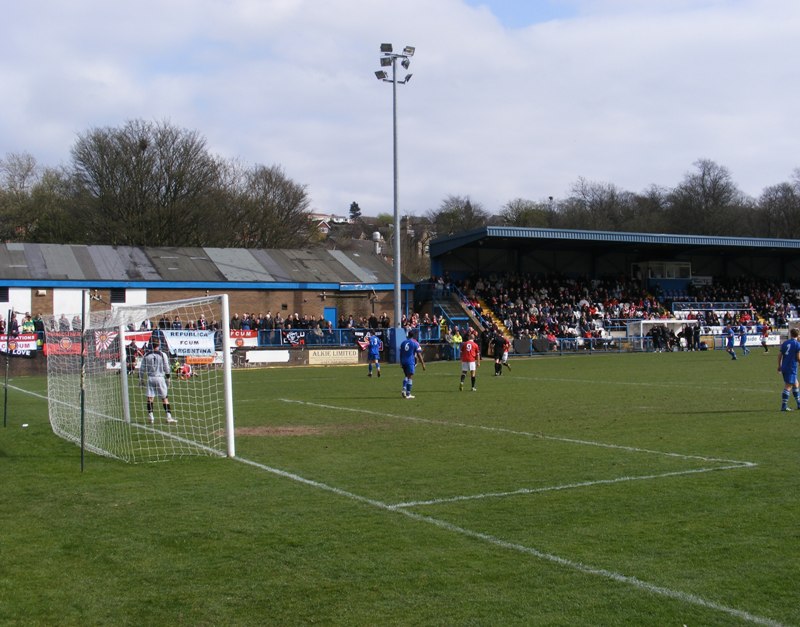
We head towards the bar before the whistle blows, just in time to beat the rush. "Players' food will only be served on production of a meal ticket," reads a sign taped to the wall, though even with the crowds FC attract there are precious few of those about at this level of football. "Ten in at a time, sorry," says the man on the door, a United fan-cum-matchday volunteer like those selling programmes, pies and lottery tickets, running the merchandise stall, operating FCUM Radio's live broadcast or hanging up the impressive array of flags: 'FC United. Cheadle Lushes!', 'Songs of Freedom' and 'Republica FCUM Margentina.' "Another twenty and that's it," says a second doorperson, looking at a line that stretches all the way back to the brick toilets.  "I heard we might be here next season," says a fan at the head of the queue. "Here?" I won't be coming if we are."


We're well into the second half when Adam Jones nods in a free-kick from the excellent Carlos Roca, prompting a brief flurry of action which sees Wolfenden nip in ahead of Clarke and substitute Nicky Platt roll the pass in for the game's fourth and final goal. "It's a better standard of football than I expected this season but we're also more inconsistent than I expected," says Mike Molloy, part-time FCUM DJ and one of the thousands of fans who part-own the club. "There are better teams around us but anything's possible with the individual ability some of our players have got." As if to underline that last point, left-back Lee Neville gets the man of the match award from the sponsors, while the club's website - whose report on the game is headlined "Rampant Reds Roll Over Mickleover." - opts for the equally impressive former Oldham and Wrexham striker Wolfenden.


Hednesford's draw with Nantwich puts United three clear in the final play-off place as they chase a first promotion since the summer of 2008, although the knot of post-match drinkers gathered around the portable TV in the neighbouring Hare and Hounds pub are more immediately concerned with the number of points about to be dropped by Manchester City.  "City have scored," one yells through to the queue at the bar. "I know, it's 3-2," comes the shouted reply.  "It was. It's three-all now." "Bollocks."

We make it back to the station bar for more beer and the famous black peas ("They're just like peas in vinegar," Andy says, declining a second spoon). The night finally draws to an end back in Manchester, where I manage to fall asleep in a Chinese restaurant at the same time as forking one last scoop of rice into my mou...zzzz.

FCUM plus beer has a way of doing that to your Saturdays. Give it a whirl.

Admission: £8
Date: 31st March 2012

Friday, 23 March 2012

Ground 209: Belle Vue, Rhyl

Things to do in Rhyl: spend the day at the indoor Suncentre, see the Sky Tower (currently closed for repair), stroll along the beach as far as Kinmel Bay in one direction or Prestatyn in the other, play mini-golf, have a ride on the Rhyl Miniature Railway, watch a show at the Rhyl Pavilion Theatre, try and win a toy in SeaQuarium's Sharky Shack Fun Zone, scoff a Corfu Kebab, have a meal in the Welsh Curry House of the Year - "Classy Kareem's is a Spicy Choice" - or head straight for one of the bars on Sussex Street: Viva, Revive, Rendezvous or JD Wetherspoon. Me? I did none of the above. I watched Rhyl FC Reserves.

Which way to the Kandy Kabin?

 "Few clubs in the Welsh Premier League have as distinguished a past as Rhyl's," the club's official website boasts.  They're not wrong. Four-time Welsh Cup winners and twice champions of the principality's big league, the team from the North Wales seaside managed fifteen successive appearances in the FA Cup first round or better between 1949 and 1963 - beating Stoke City, Barnsley and Notts County along the way - and  knocked Lithuania's FK Atlantas out of the 2005-6 UEFA Cup before exiting over two legs to Roy Hodgson's Viking Stavanger. Beat that Afan Lido.

Rhyl's problem is that they're not actually in the Welsh Premier League. Now volunteer-run, the 140-year-old club had the eject button pushed on them at the end of the 2009-10 season, sent down to the Cymru Alliance despite finishing sixth in the eighteen-team top-division.  "The standard we have reached has exceeded the ability to finance itself," former club secretary Joe Pearson-Furnival told the WPL website. "We get very little financial help from our own FA and the financial demands of the players has now caught up with the lower leagues in the English game."  While pushing for promotion on the pitch, the club have made improvements off it too.  Nonetheless, finances remain tight: signs invite local companies to sponsor a seat for £5 a season and the club recently had to ask fans to help raise the £2,000 cost of repairing their pitch mower.


Tonight's game is the semi-final of the North Wales Coast FA Intermediate Cup, the club's second stringers taking on Rhyl Athletic, formed in 2009 and currently midtable in the Clwyd Football League Premier, two divisions below Rhyl's first team. Before kick off the couple of hundred fans manage a rousing minute's applause in honour of the recently deceased John Wright, head steward, junior football coach, general manager of the reserve team and father figure to many at the club. Executive seats are reserved for members of the Wright family, the home players warming up with RIP John printed on the front of their t-shirts and personalised messages written across the back.

"Pass it," "Keep it," "Win it," "Get the ball," "Shit!" the visiting bench shouts, though their team matches the home side until midway through the opening half when James Stead controls a pass on the right wing and slams it over the Athletic keeper's head into the far corner of the net.  "Great goal," says the very friendly woman who's just sold me a pie and polystyrene cup of tea for the bargain price of £2.50.  "What do you do for a pound?" ask a couple of teenagers. "You can have chips, you can have two sausage rolls, two bars of chocolate."  "Where are they tomorrow?" asks another customer. "We're away at Connah's Quay.  I'll have to watch it on Twitter."


In Mike Hulse, James Malloy and ex-Oldham Athletic junior Stead, the home side have the game's three most lively and inventive attackers.  Athletic have a lot of possession but their attempts to work openings down the right founder every time they reach the edge of the area.  Two minutes after the interval Stead adds the second goal via a free kick which takes a deflection and goes over the goalkeeper's head.  "Sunny Rhyl, sunny Rhyl, sunny Rhyl," a few children start chanting behind a skull and crossbones flag that has the words 'Sunny Rhyl West End Boys' emblazoned across it  in white.  The hardworking Malloy adds a third six minutes later as the home side, pacier and sharper on the ball, begin to dominate, though some good goalkeeping, several subsitutions and the linesman's flag combine to keep the score at three-nil.  Rhyl go through to the final to await the winners of Beaumaris Town versus Prestatyn Rovers. With the first team second in the league and into a semi-final of their own, the sun might not quite be back out yet - but it's definitely inching through the clouds.
 
Date: March 23rd 2012
Admission: £3 (£6 for first-team games)

  • The Belle Vue's been Rhyl's home ground since 1900.  A ten-minute walk from the town's bus and train stations - turn into Brighton Road at Apollo Bingo, take a right over the railway tracks just after Tongs Funeral Services and you'll see the floodlights just before you get to the Millbank pub - the tidy ground has four all-seater stands - three of them covered - and open steps in each corner where the smokers congregate.  Seats come in a choice of yellow, sky blue or two shades of green. 
  • Rhyl's greatest ever player is Don Spendlove, scorer of 629 goals in sixteen seasons with the club and rated by some as the best non-league footballer ever. With a young family settled in North Wales, the striker turned down a £5,000 move to Spurs in the early-1950s, a period when he averaged over seventy goals a season. "Rhyl had always been good to me and I wasn't looking to leave," he later said. "The first I heard about the Spurs approach was when I read it in the papers. I've never regretted not moving or wondered what might have been."

Saturday, 17 March 2012

Ground 208: Craik Park, Morpeth

It's been a tumultuous few years for Morpeth Town FC.  After three seasons in the upper echelons of the Northern League top flight, the Northumberland club slumped to 21st in 2010 and from there to the foot of the two-division league just twelve months later.  Along the way they lost three managers, two squads of players, had to groundshare for a year at Bedlington Terriers while their own facilities were repaired to Northern League standard, and only managed to avoid successive relegations because, with only two clubs from the feeder leagues eligible for promotion, there was still a spare place in Division Two. "I've lost two stones since I took this job, had to take off a fortnight off work through stress and am still spending every spare moment here," chairman Jim Smith said.  "I'm getting experience here," player-manager Trevor Benjamin told the Daily Mail last year. "A different experience."


The support of Ken Beattie - described by Northern League chairman Mike Amos as a "long time former Morpeth player, chairman, benefactor, bankroller and occasional source of much head banging frustration" -  kept the club alive through years of two-figure attendances, the ticket revenue barely enough to cover the £120 that had to be split between the match officials after every home game.  Last season, beset by vandalism and without any heating at their ground, Town came within weeks of folding altogether near the close of a thirty-eight game campaign that ended with four wins, thirty-one defeats and a goal difference of minus ninety-eight.


Benjamin had arrived in September after twenty-seven clubs, an England Under-21 cap and a £1.3 million move from Cambridge to Leicester, where he was signed to replace the Liverpool-bound Emile Heskey and left five years and eleven goals later [insert own joke here]. Unable to stem the tide on or off the pitch, Benjamin and assistant manager Oliver Bernard departed at the end of the season, Nick Gray and half his Seaton Delaval Amateurs side brought in as replacements. After a slow start - just two points coming from their opening four league games - Gray's team have shot up to second in the table on the back of fourteen consecutive home wins and the forty-six goals shared by Steven Anderson, Chris Lunn, Ashley McAlpine and David Dormand. With seven games remaining and third-placed Gillford Park the visitors next weekend, a place in Division One is suddenly Morpeth's to lose - a massive turnaround for a side who began the season with few more ambitions than to avoid being  "one of the whipping boys".


Beaten last time out by promotion challengers Hebburn Town, midtable Whitehaven have little more to play for than the mood on the hundred-mile bus journey home. They arrive with just two substitutes; their starting eleven has a right-back in a number ten shirt and a centre-forward wearing number two.  "We're all here, as usual," says one of a group of three pensioners taking up a seat in the covered stand. "It's terrible, Jack. For a town the size of Morpeth it's pathetic." "Ah kna," agrees his mate, "they could play in the market place and people still wouldn't bother going. I was here midweek and there was a crowd of thirty-six. Thirty-six!" "I was away," the third one says, apologetically fingering the Morpeth scarf draped around his neck. "By, it's busy up here," jokes a woman in a club jacket, arriving from the garden shed that's been converted for use as a turnstile booth. The reporter from the local Sunday paper finishes copying down the teams from a whiteboard propped against the clubhouse wall, making a crowd of five in the back of the hundred-seater stand.  Conifer hedges keep the vandals out and a mud track, once used by Morpeth Harriers Athletic Club, loops around the pitch. "Looks more like a greyhound stadium," says James Williams, now on leg thirty-nine of his attempt to visit all forty-four Northern League grounds in a single season.  "I think this is the first time I've had nice weather at a game since Chester-le-Street in August."  Morpeth's substitutes warm up with an orange ball, an upturned wheelbarrow and a metal pitch roller behind either goal.  The teams come out, their studs clattering on the concrete path, and form two lines for the ritual handshakes: "All the best", "All the best", "All the best", "Have a good 'un", "All the best", "All the best".  I count twenty-one people, one dog and six cameras spread along the touchline, a couple dozen more drifting out of the bar once the game gets underway.


With Morpeth's giant defenders mopping up everything at one end of the pitch and the their midfield still finding its range at the other it takes twenty minutes for either side to fashion anything approaching a chance, Chris Lunn crossing for Andrew Keenan, who flicks his header wide of Whitehaven keeper Stuart Pettit's left-hand post.  Morpeth have a goal disallowed, hit the post twice, have a shot booted off the line and a promising attack foiled by some debatable decision making from the assistant on the far side of the pitch. "How the hell can you play yersel' offside, liner?" asks a Morpeth fan. "Even me dog could've spotted that one, man." "Ref, that's fucking embarrassing that, like," laughs a player. "The worst decision I've ever seen from any official," thinks James. Morpeth play a direct game, Whitehaven a disconnected one, their two forwards left to chase after balls that end up on the running track before the second bounce. "It's impressive enough that they turn up, the distance they have to travel every other week," James says. At half time everyone troops into the clubhouse, where there are pies on plastic plates, hot drinks in china mugs and racing from Newcastle on Teletext, the Six Nations rugby relegated to background noise.


Gray swaps a midfielder for a forward at the start of the second half, Connor Andrews replacing Jordan Fry.  Andrews stumbles over his first chance at goal but tucks the second into the corner of Pettit's goal with half an hour still to play.  Steven Anderson adds a quick second, the clang of metal drowned out by cheers as his shot goes in off the post, and Danny Young, on for Chris Lunn, scores a third, collecting a pass from Callum Morris and skipping past two defenders on the edge of the box. In between,  Steven Mundy beats a goalbound Leigh Dunn shot away as the visitors briefly enjoy their best spell of the game.  "Deeper rather than tighter, now.  Deeper rather than tighter," comes the shout from Whitehaven's underpopulated bench. "You're playing for your pride now."  

"Torned caad, hasn't it?" says a Morpeth fan as the referee blows for full-time. "Mind, another good win." With Hebburn taking three points at Gillford Park, it's a vital one too.

Date: March 17th 2012
Admission: £4

  •  Morpeth Town have been around since 1894, when Morpeth United and Morpeth FC set up home together on Stobhill Cricket Field.  The club spent half a century in the Northern Football Alliance before stepping up to the Northern League on their one hundredth anniversary, winning the Division Two title in their first season and finishing sixth in Division One and Northumberland Senior Cup runners-up in their second.  In 1998-99 they made it to the final qualifying round of the FA Cup, losing 1-0 at home to Nigel Clough's Burton Albion. Eight years later they lifted the Northumberland Senior Cup for the first time since 1903, beating Conference North side Blyth Spartans 3-2 at Newcastle United's St James' Park.  

Thursday, 15 March 2012

Chopwell Soviets FC and County Durham's Little Moscow

"CHOPWELL Officials are ready to resign from the Division One after enduring a traumatic start to the campaign. Chopwell, who have had a team in the Northern Alliance for twelve years, won promotion to the Premier Division for the 2003-2004 season but were immediately relegated - and things have not gone well since." - Newcastle Evening Chronicle, November 17th 2010.

When the nine-day General Strike was called on May 4th 1926, Chopwell's miners had already been out for a year in a dispute that began over wage cuts and working hours.  Marchers stripped the Union Jack from the front of the council office and replaced it with the hammer and sickle.  A Communist Sunday school was set up, copies of Marx were subsituted for bibles on church lecterns, and a new banner - replacing a 1907 image of pioneering Labour MP J.W. Taylor - was unveiled by the Irish trades unionist James Larkin, bearing portraits of Karl Marx, Vladimir Ilyich Lenin and James Keir Hardie. When the Flying Scotsman, carrying hundreds of passengers, was derailed outside Cramlington in protest at trains continuing to transport coal in defiance of the lock-out, miners from the village were alleged to be among the forty or so men involved. A new police division was created specifically to deal with Chopwell, while the local press howled in outrage. “Under the Red Banner,” “Clutching Hand of Communism” and “Spectre of a Miniature Russia” the Newcastle Chronicle wrote; other newspapers called it the “reddest village in England.” Today, more than forty years after Chopwell Colliery closed for good, there are still streets named after Hardie, Marx and Lenin, and people who remember the village by its former nickname: Little Moscow.


Chopwell's Communist Club -  funded by Kodak UK managing director George Davison and one of only three anywhere in the country - was established in December 1913, a fortnight into a strike at the pit. In what the police later called "a strange coincidence", on the same night the club opened its doors twenty-six coal trucks were set loose down a hill in the village, causing £3,000 worth of damage to a colliery railway. "The Chopwell boys came in their dozens, each an embryo fighter," one of those in attendance at an Anarchist conference held in Newcastle the following year observed approvingly. Between the wars militancy in the village - located between Blaydon and Consett in the north-west of the County Durham coalfield - ebbed and flowed. "The only Communist there on May 1st 1926 was a young lad who had joined the Party in his teens," noted R. Page Arnot. "Three months later I addressed the Chopwell Communists on a hillside as no hall would hold the 200 members present." By the the mid-1930s, there were only four card-carrying members left.


In Little Moscows, wrote Stuart Macintyre in the March 1979 issue of Marxism Today, "workers' sport (was)...part of an affirmative endeavour to create their own style of living".  As in other mining areas, much of the support, funding and players for Chopwell's football clubs came directly from its colliery.  Chopwell Institute gained membership of the Northern Football Alliance in 1919, winning the first of two titles in their second season in the league. Club officials later attempted to change the name to Chopwell Soviets only for the Durham FA to vehemently refuse its registration. George McNestry, who went on to make over 250 appearances in a professional career spanning Leeds United, Sunderland, Luton, Bristol Rovers and Coventry, and Billy Bell, later of Lincoln, Leicester City and Torquay, both started out at the club. Tommy Dawson played for Stoke City and Clapton Orient; Charlie Parker, once of Stoke, Sunderland and Carlisle United, made the opposite journey, finishing his playing days with Institute at the tail-end of the 1920s.  In 1936, Institute were joined by Chopwell Colliery, the new club lifting the inaugural Northern Alliance Cup at the close of their first season. Chopwell Top Club were later members of the Alliance from 1998 to 2006; the last remaining village team, Chopwell Officials Club, folded in November 2010 when their secretary and manager resigned and no replacements could be found. In Village VoiceIan Cusack  memorably wrote of a visit to Officials Club in what would turn out to be their final full season. "Eventually we came across a blasted heath masquerading as Warsaw circa 1972...the pitch was scarred by the efforts of burrowing rodents, resulting in a home substitute catching a somnolent rabbit, breaking its neck and throwing the corpse behind the goal for a pair of Jack Russell terriers to squabble over. We weren't among the Cafe Society here." The pitch - now used as a venue for Tesco skills coaching sessions - is reached by a path from the intersection of Lenin and Marx Terrace (Joseph Terrace and Frederick Street are both nearby).  A Newcastle United top dries on a line beside a Stella Artois parasol, there's a boy scout hut with bricked-up windows and a sign for a lost Border Collie sellotaped to a streetlight.  Like the rest of the village, the ground is well maintained, with white rails around the touchline, painted huts for dugouts and a park bench overlooking the cricket pitch. I don't get any closer than a locked gate by a bowling green. "Lovely morning, isn't it?" says a man out walking his dog.

Autumn in the ancient forest of Chopwell Woodlands Park

The mine itself has long since disappeared, marked only by a pit wheel at the side of a street.  They'd been digging for coal in Chopwell as early as 1530, though it took the arrival of the Consett Iron Company in 1896 for industrial-scale mining to commence.  By the mid-1920s two thousand men and boys were working three different shafts, but the final seam closed the year England won the World Cup and on January 28th 1967 Chopwell's mining history came to a full stop.  The village's radicalism has proved more enduring, often lingering in the most surprising of places.  In the early-1950s the colliers presented their banner to a delegation led by the president of the central committee of Soviet mineworkers. It was temporarily exhibited in Gorlovka, the east Ukrainian mining town where future Tottenham and West Ham United striker Serhiy Rebrov was raised, before being taken for display in the Moscow Trades Hall. A replacement was unfurled by Arthur Horner, founding member of the Communist Party of Great Britain, jailed volunteer in James Connolly's Irish Citizen Army and then General Secretary of the NUM, in the centre circle of Chopwell's football pitch in 1954.  Almost half a century later, the French Miners' Federation paraded it behind the World Cup winners as they marched in triumph through the centre of Paris.

Sunday, 11 March 2012

Ground 207: Focus Scaffolding Sports Complex, Whitehaven Amateurs

Alan Armstrong is first across the Hebburn Sports and Social Ground carpark, hauling a bag of strips two-handed towards the coach.  "Are you the kitman today, Alan?"  Andy Hudson asks between drags on his cigarette.  "Kit man, press officer, floodlight operator and rubbish picker-upper," Armstrong laughs.  Tom Derrick, the club secretary, has a sign with 'Hebburn Town Official Sponsor' for the window.  Treasurer John Bolam is here to see the coach off before watching Sunderland in the afternoon, while committee member Paul Hill sits with his head down at the front, picking out his bets in the morning paper. "Quarter to ten and we can't see a player," chairman Billy Laffy says.  "Urine only, mind," warns the driver. "I've taken the bog roll out."  Liam McBryde, John Toomey and Callum Charlton turn up five minutes late, dressed in matching club tracksuits. "I had to work with me da this morning," Charlton apologises. "I've had me tracksuit on since half six."  Most of the squad get on at the Silverlink Travelodge after a delay caused by a missed alarm call, two cigarette breaks and a trip to the shops.  Manager Paul Bennett has been waiting half an hour by the time we pull in at a bus stop near Tyne Met College.  Jamie McClen, who made twenty-five first team appearances for Newcastle United under Ruud Gullit and Sir Bobby Robson, is picked up on a slip road, we meet two players at the Corner House in Heaton, Alex Benjamin - the Northern League's top scorer last season with 39 goals - outside a branch of Go Outdoors, and defender Dan Kirkup in Haydon Bridge.  "We are stopping at a McDonald's, aren't we?" asks a player from the back of the bus.


Midfielder Paul King's spent forty minutes looking for his shin pads and is taking a pair of scissors to his flip-flops to use instead (he eventually finds the pads in a kit bag, left behind after the previous game).  McClen - a genuinely nice bloke who serves as a mentor to the younger players at the club - jokingly sent Bennett a picture message of his monthly payslip at Newcastle with the words "Am I really going to Whitehaven?"  "Who thinks Robin Van Persie will go?" Dean Nicholson, an ex-professional at West Bromwich Albion, asks.  "I've never understood," starts someone else, "how sheep can stand on hills as steep as that and not fall over."  We pull up in Carlisle, the players piling out to a supermarket and returning with Lucozade and crisps.  "Have you got your team?" Derrick asks. "I've been bouncing it around, I just haven't written it down yet," says Bennett. "It's only one o'clock."

Manager Paul 'Harry Hill' Bennett

 Except for Derrick, who has paperwork to do at the ground, the committee get dropped off outside Wetherspoons in the town centre, walking the fifteen minutes to the Focus Scaffolding Sports Complex just in time to see the teams kick off.  Two flatpack stands back on to the rugby ground, there's a clubhouse in one corner and fenced-off all-weather pitches on two of the four sides.  The C2C cycle route and the West Cumbria Coastal Railway pass within  a few metres of the far goal. "Plenty of trains, aren't there?" a Hebburn fan tells his mate. "Last stop for those is Sunderland, isn't it?" "Aye, poor bastards."


"These four games could decide whether we go up or not," Bennett told the Newcastle Evening Chronicle after last week's home win over Brandon moved his team up to sixth, five points off second-placed Morpeth but with a game still in hand.  He starts 4-5-1, with Liam McBryde - 35 goals in 33 games so far this season - preferred to Benjamin in attack.  With Jeff Forsyth and Dan Kirkup utterly dominant in defence and Paul Gardiner pulling strings in midfield, Hebburn start impressively, taking a deserved lead when Stuart Pettit turns McBryde's goalbound shot round the post and Tony Stephenson scores his 15th of the season from the resulting corner. The visitors nearly double their lead a minute before half-time but Pettit stops McBryde for a second time, diving full-length to push his penalty kick away. "Ideal height but a hell of a save," Paul Hill says. "Was that a miss or or a save?" I ask the striker after the game. "Same thing for me."


The save gives Whitehaven renewed impetus, Leigh Dunn levelling with his 20th league goal of the season after the normally unflappable Dan Reagan drops a corner onto his head. Hebburn kick off, the ball kicked forward to McBryde, who squeezes his shot over Pettit and in at the post. "Two goalkeeping mistakes in a minute," says Billy Laffy.  Gardiner makes it three, Lee Harrison's free-kick parried straight on to his right boot, but Jonny Donat cuts the lead again with twenty minutes left and Whitehaven almost grab a point, striking the bar as the referee takes a first look at his watch. "It's a long way to come for a heart attack," Laffy jokes. With Birtley held at home by Alnwick, the three points lift Hebburn up to fifth.  "Eeh aye eeh aye eeh aye oh, up the Northern League we go," the players sing on the bus journey home after celebratory chip and sausage sandwiches in the Whitehaven clubhouse.  McClen - who plans to retire once the season finishes at the age of 32 - gives his teammates marks out of ten, Jeff Forsyth getting man of the match by popular acclaim.  The day ends as it began, back at Hebburn Sports Ground - Paul Bennett joining his players for a pint.

"Morpeth are one-nil up." Dean Nicholson checks the other scores.


Date: March 10th 2012
Admission: £4

Tuesday, 6 March 2012

Ground 206: Gayfield Park, Arbroath

September 12th 1885 was the first round of the Scottish Cup - and a bad day for Aberdeen's amateur sportsmen. The match referee estimated Dundee Harp had beaten Aberdeen Rovers 37-0, though one of the home officials counted two goals fewer. The two agreed to settle on the lower figure, allowing the Harp team to retire to a celebratory tripe and potato supper at a Dundee pub.  On the same afternoon, eighteen miles up the North Sea coast, two more Aberdeen sides were among the first round losers.  The first went down 7-0 away to Strathmore.  The second, more famously, were battered 36-0 at Arbroath FC.

 Floodlights! Football ground! Pub! Sea! Amusement arcade! Erm, crocuses...

The enduring legend has it that Arbroath were supposed to be playing Orion FC, one of the three clubs which later banded together to form the modern-day Aberdeen.  Instead, the Scottish FA mistakenly sent a letter of invitation to Orion Cricket Club, who, anything for a lark,  adopted the city's motto of Bon Accord as a team name, left their bats and pads behind and turned up in Arbroath without any kit.  It's a version of history which has since been disputed, with some maintaining they were just a very bad football team, less Dennis Compton than Paul Jewell's Derby County. Either way, Arbroath had struck fifteen goals past visiting wicketkeeper Andrew Lornie by half-time - his opposite number, Jim Milne, watched from under an umbrella borrowed from a friend in the crowd - while 18-year-old John Petrie went on to get his leg before goal thirteen times, an achievement only equalled by Archie Thompson during Australia's 31-0 win over American Samoa in the qualifying rounds of the 2002 World Cup. The scoreline itself was eventually beaten as a senior record when Stade Olymique L’Emyrne's players decided to score 149 own goals against AS Adema on the final day of the 2006 Madagascan League season, which, no matter how you look at it, very definitely wasn't cricket.


As at Dundee Harp, the final margin of victory could even have been greater. "My only regret was that I chalked off seven goals, for while they may have looked doubtful from an offside point of view, so quickly did the Maroons carry the ball from midfield, and so close and rapid was their passing, that it was very doubtful whether they could be offside," referee Dave Stormont later admitted, though if his running style was as long-winded as his manner of speech, it's no wonder he couldn't keep up with play. "The leather was landed between the posts 41 times, but 5 of the times were disallowed...the Aberdonians might as well have been outside the ropes for the resistance that they provided, " sniffed the Scottish Athletic Journal.  The game was "a farce" wrote the Arbroath Guide.  Neither hints at the quality of an Arbroath team which scored sixteen in winning the next two rounds, three in losing at Hibernian, and ended the season with 178 goals in just 42 games. Two seasons later Arbroath finally met the real Orion FC - and thrashed them 18-0. Aberdeen had to wait another sixty years for its revenge, winning 2-0 in a 1947 Scottish Cup semi-final watched by 22,000 at Dundee's Dens Park.


Before last season's Third Division title, that game was as close as the club had come to a national trophy in 133 years. Like the proverbial London buses, Arbroath fans mightn't have long to wait for another, Pat Sheerin's side currently just a point behind leaders Cowdenbeath with three quarters of the league campaign played.  Brian Kerr - a Scotland international formerly of Newcastle United, Hibernian and Motherwell - and ex-Plymouth and St Johnstone winger Kieran McAnespie start on the bench for Arbroath.  East Fife, trailing Stenhousemuir as they try and squeeze into the end-of-season play-offs, dispensed with manager John Robertson after their midweek defeat at Forfar and have Gordon Durie in charge for the first time.  Yes, that Gordon Durie.

You looking at me?

For me, the highlight is on the other side of the pitch, where the North Sea comes to within a tarmac footpath of Gayfield Park's East Terrace at high-tide.  If you're planning a visit youself,  the Bermudas and beach ball are best left in the car. "No matter how good the weather is take a coat!" advises the entry in the Scottish Ground Guide. "A lovely place on a nice day," a Dumbarton fan told me. "Thing is, I don't think they've ever had one."  That said, I come as close as I've ever done to love at first sight as the sun breaks through at a minute to three and the players come out to The Undertones - "He always beat me at Subbuteo, 'cos he flicked the kick and I didn't know". The steak pies actually contain meat, I'm standing on a terrace fifteen metres from the sea and both sets of fans are scurrying round the pitch like a fast-forward shot of a Tokyo commuter station as the teams swap ends for kick-off.  Good old life.


 Arbroath are a goal up after six minutes and two ahead by fifteen, Trinidad and Tobago's Collin Samuel crossing from left then right, Liam Caddis - a Scottish Under-19 international on-loan from St Johnstone - twice guiding the ball into the bottom corner of Michael Brown's net.  The first strike is accompanied by a blast of The Pogues, the second, slightly spoiling things, by the more predictable sound of James Brown wailing 'I Feel Good'. It's not so good for long, the two-goal lead cut in half the moment Ryan Wallace's pass meets Robert Sloan shortly before the half hour. Stung by the unexpected goal, Arbroath charge back, Steven Doris sidefooting straight at Brown from six yards. "You cannae miss that!" rages a home fan, prophetically.  Two minutes before the break, Wallace lays on the equaliser, Steven Hislop nodding in past Darren Hill at the far post. "It's all the goalkeeper's fault," says an Arbroath fan, wandering off in search of a pie.


 Hill keeps the score level early in the second half, springing to his right to turn a goalbound shot around the post. For the neutral, it's an entertaining, full-blooded forty-five minutes of football.  East Fife have the best of the possession and chances but look stretched whenever Arbroath get the ball forward. Neither side quite manages to score, despite Fife's David White seeing red in both senses of the word, remonstrating with the player he's just deposited on the ground as the referee brandishes a second yellow card. "At last! Should have been off fucking ages ago," reckons a steward. "Seven bad challenges and he'd not even had a talking to." It's the second time in three days Arbroath have thrown away a two goal lead, resulting in an epic bout of swearing from the Gayfield Park fans.  "Fucking awful",  screams one. "This is rubbish," shouts another. "Pathetic, Arbroath. Absolute shite!"  The first-half goalkeeping critic is slightly more constructive: "We're not going to win the league playing like this, are we?" he asks. Despite Cowdenbeath dropping two points at Airdrie, it's a question that doesn't need a reply.


Date: March 3rd 2012
Admission: £12 (plus £3.20 for a properly delectable steak pie and Bovril)

  • Gayfield Park's a ten-minute walk from Arbroath Station, on the line between Dundee and Aberdeen.  The closest bar to the ground  is the Tutties Neuk. There's a Wetherspoon's, the Corn Exchange, in the market place by the harbour. A few minutes from the station, Lochlands has real ales on tap, Arbroath shirts on the wall and framed photos of every Scotland World Cup squad. Moustaches galore.
  • Along with John Petrie, George Mutch and Ned Doig are the two most famous Arbroath players you've probably never heard of.  Mutch left Gayfield for Manchester United, later scoring a last-minute penalty winner as Preston North End won the first televised FA Cup Final in 1938.  Doig, a young outside right, turned up to watch Arbroath a year after the first-team had played Bon Accord. Realising the home side were about to start without a goalkeeper, someone in the crowd yelled  "Let Ned Doig play."  When he eventually retired in 1908, Doig had won four English titles with Sunderland, six caps for Scotland, been promoted as champions with Liverpool and kept goal over 1,000 times in a 25-year career. A note to any teenagers reading who still turn up at games wearing shin pads and full replica kit: give it up, that kind of thing doesn't happen more than once.
  • The only other two times I saw Arbroath play, they went down to last-minute goals at Alloa  and Dumbarton.  Probably just a coincidence...